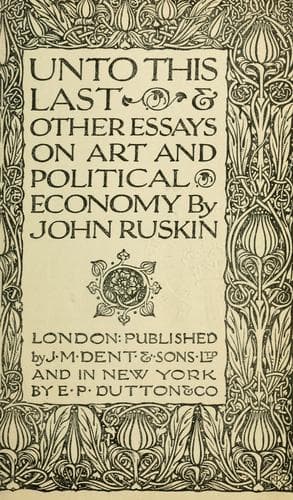
Unto This Last, and Other Essays on Political EconomyRuskin, John
General
Unto This Last, and Other Essays on Political Economy
Ruskin, John
Art; Economics
Well, that is the first way, then, in which you will employ your
intellect well; and the simple observance of this plain rule of
political economy will effect a noble revolution in your architecture,
such as you cannot at present so much as conceive. Then the second way
in which we are to guard against waste is by setting our men to the
easiest, and therefore the quickest, work which will answer the
purpose. Marble, for instance, lasts quite as long as granite, and is
much softer to work; therefore, when you get hold of a good sculptor,
give him marble to carve--not granite. That, you say, is obvious
enough. Yes; but it is not so obvious how much of your workmen's time
you waste annually in making them cut glass, after it has got hard,
when you ought to make them mould it while it is soft. It is not so
obvious how much expense you waste in cutting diamonds and rubies,
which are the hardest things you can find, into shapes that mean
nothing, when the same men might be cutting sandstone and freestone
into shapes that meant something. It is not so obvious how much of the
artists' time in Italy you waste, by forcing them to make wretched
little pictures for you out of crumbs of stone glued together at
enormous cost, when the tenth of the time would make good and noble
pictures for you out of water-colour. I could go on giving you almost
numberless instances of this great commercial mistake; but I should
only weary and confuse you. I therefore commend also this head of our
subject to your own meditation, and proceed to the last I named--the
last I shall task your patience with to-night. You know we are now
considering how to apply our genius; and we were to do it as
economists, in three ways:--
To _various_ work;
To _easy_ work;
To _lasting_ work.
This lasting of the work, then, is our final question.
Many of you may, perhaps, remember that Michael Angelo was once
commanded by Pietro di Medici to mould a statue out of snow, and that
he obeyed the command.[7] I am glad, and we have all reason to be
glad, that such a fancy ever came into the mind of the unworthy
prince, and for this cause: that Pietro di Medici then gave, at the
period of one great epoch of consummate power in the arts, the
perfect, accurate; and intensest possible type of the greatest error
which nations and princes can commit, respecting the power of genius
entrusted to their guidance. You had there, observe, the strongest
genius in the most perfect obedience; capable of iron independence,
yet wholly submissive to the patron's will; at once the most highly
accomplished and the most original, capable of doing as much as man
could do, in any direction that man could ask. And its governour, and
guide, and patron sets it to build a statue in snow--to put itself
into the service of annihilation--to make a cloud of itself, and pass
away from the earth.
[7] See the noble passage on this tradition in "Casa Guidi
Windows."
Public-domain text, read in full here on John Shaqi.
Reviews
Reviews
No reviews yet
Be the first to share your thoughts on this work.
Join the Discussion
Join the discussion
Sign in to leave a comment or review.
Sign InorCreate an account