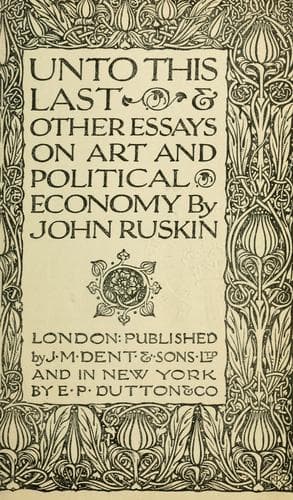
Unto This Last, and Other Essays on Political EconomyRuskin, John
General
Unto This Last, and Other Essays on Political Economy
Ruskin, John
Art; Economics
Thus, then, the real working power or worth of the currency is founded
on the entire sum of the relative estimates formed by the population
of its possessions; a change in this estimate in any direction (and
therefore every change in the national character), instantly alters
the value of money, in its second great function of commanding labour.
But we must always carefully and sternly distinguish between this
worth of currency, dependent on the conceived or appreciated value of
what it represents, and the worth of it, dependent on the existence of
what it represents. A currency is true or false, in proportion to the
security with which it gives claim to the possession of land, house,
horse, or picture; but a currency is strong or weak, worth much or
worth little, in proportion to the degree of estimate in which the
nation holds the house, horse, or picture which is claimed. Thus the
power of the English currency has been, till of late, largely based on
the national estimate of horses and of wine: so that a man might
always give any price to furnish choicely his stable, or his cellar,
and receive public approval therefor: but if he gave the same sum to
furnish his library, he was called mad, or a Bibliomaniac. And
although he might lose his fortune by his horses, and his health or
life by his cellar, and rarely lost either by his books, he was yet
never called a Hippomaniac nor an Oinomaniac; but only Bibliomaniac,
because the current worth of money was understood to be legitimately
founded on cattle and wine, but not on literature. The prices lately
given at sales for pictures and MSS. indicate some tendency to change
in the national character in this respect, so that the worth of the
currency may even come in time to rest, in an acknowledged manner,
somewhat on the state and keeping of the Bedford missal, as well as on
the health of Caractacus or Blink Bonny; and old pictures be
considered property, no less than old port. They might have been so
before now, but it is more difficult to choose the one than the other.
Now, observe, all these sources of variation in the power of the
currency exist wholly irrespective of the influences of vice,
indolence, and improvidence. We have hitherto supposed, throughout the
analysis, every professing labourer to labour honestly, heartily, and
in harmony with his fellows. We have now to bring farther into the
calculation the effects of relative industry, honour, and forethought,
and thus to follow out the bearings of our second inquiry: Who are the
holders of the Store and Currency, and in what proportions?
Public-domain text, read in full here on John Shaqi.
Reviews
Reviews
No reviews yet
Be the first to share your thoughts on this work.
Elsewhere in the archive
Join the Discussion
Join the discussion
Sign in to leave a comment or review.
Sign InorCreate an account