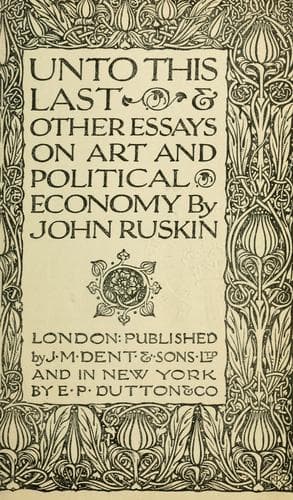
Unto This Last, and Other Essays on Political EconomyRuskin, John
General
Unto This Last, and Other Essays on Political Economy
Ruskin, John
Art; Economics
Let _a_ need one hour's work, _b_ two, and _c_ four; then the day's
work must be seven hours, and one man in a day's work can make 7_a_,
or 3-1/2_b_, or 1-3/4_c_. Therefore one A works for _a_, producing
7_a_; two B's work for _b_, producing 7_b_; four C's work for _c_,
producing 7_c_.
A has six _a_ to spare, and gives two _a_ for one _b_, and four _a_
for one _c_. Each B has 2-1/2_b_ to spare, and gives 1/2_b_ for one
_a_, and two _b_ for one _c_. Each C has 3/4 of _c_ to spare, and
gives 1/2_c_ for one _b_, and 1/4 of _c_ for one _a_. And all have
their day's maintenance.
Generally, therefore, it follows that, if the demand is constant,[87]
the relative prices of things are as their costs, or as the quantities
of labour involved in production.
[87] Compare "Unto This Last," p. 177, et seq.
Then, in order to express their prices in terms of a currency, we
have only to put the currency into the form of orders for a certain
quantity of any given article (with us it is in the form of orders for
gold), and all quantities of other articles are priced by the relation
they bear to the article which the currency claims.
But the worth of the currency itself is not in the slightest degree
founded more on the worth of the article for which the gold is
exchangeable. It is just as accurate to say, "So many pounds are worth
an acre of land," as "An acre of land is worth so many pounds." The
worth of gold, of land, of houses, and of food, and of all other
things, depends at any moment on the existing quantities and relative
demands for all and each; and a change in the worth of, or demand for,
any one, involves an instantaneously correspondent change in the
worth, and demand for, all the rest--a change as inevitable and as
accurately balanced (though often in its process as untraceable) as
the change in volume of the outflowing river from some vast lake,
caused by change in the volume of the inflowing streams, though no eye
can trace, no instrument detect motion either on its surface, or in
the depth.
Public-domain text, read in full here on John Shaqi.
Reviews
Reviews
No reviews yet
Be the first to share your thoughts on this work.
Elsewhere in the archive
Join the Discussion
Join the discussion
Sign in to leave a comment or review.
Sign InorCreate an account