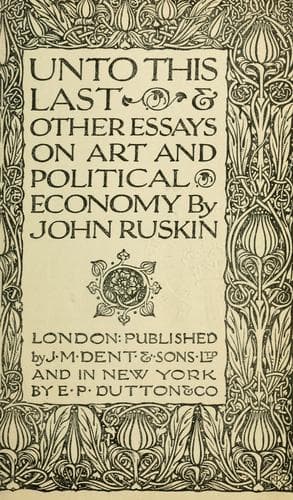
Unto This Last, and Other Essays on Political EconomyRuskin, John
General
Unto This Last, and Other Essays on Political Economy
Ruskin, John
Art; Economics
But in proportion as the habits of the nation become complex and
fantastic (and they may be both, without therefore being civilized),
its circulating medium must increase in proportion to its store. If
everyone wants a little of everything,--if food must be of many kinds,
and dress of many fashions,--if multitudes live by work which,
ministering to fancy, has its pay measured by fancy, so that large
prices will be given by one person for what is valueless to
another,--if there are great inequalities of knowledge, causing great
inequalities of estimate,--and finally, and worst of all, if the
currency itself, from its largeness, and the power which the
possession of it implies, becomes the sole object of desire with large
numbers of the nation, so that the holding of it is disputed among
them as the main object of life:--in each and all these cases, the
currency enlarges in proportion to the store, and, as a means of
exchange and division, as a bond of right, and as an expression of
passion, plays a more and more important part in the nation's
dealings, character, and life.
Against which part, when, as a bond of Right, it becomes too
conspicuous and too burdensome, the popular voice is apt to be raised
in a violent and irrational manner, leading to revolution instead of
remedy. Whereas all possibility of Economy depends on the clear
assertion and maintenance of this bond of right, however burdensome.
The first necessity of all economical government is to secure the
unquestioned and unquestionable working of the great law of
Property--that a man who works for a thing shall be allowed to get it,
keep it, and consume it, in peace; and that he who does not eat his
cake to-day, shall be seen, without grudging, to have his cake
to-morrow. This, I say, is the first point to be secured by social
law; without this, no political advance, nay, no political existence,
is in any sort possible. Whatever evil, luxury, iniquity, may seem to
result from it, this is nevertheless the first of all Equities; and to
the enforcement of this, by law and by police-truncheon, the nation
must always primarily set its mind--that the cupboard door may have a
firm lock to it, and no man's dinner be carried off by the mob, on its
way home from the baker's. Which, thus fearlessly asserting, we shall
endeavour in the next paper to consider how far it may be practicable
for the mob itself, also, in due breadth of dish, to have dinners to
carry home.
III.
THE CURRENCY-HOLDERS AND STORE-HOLDERS. THE DISEASE OF DESIRE.
It will be seen by reference to the last paper that our present task
is to examine the relation of holders of store to holders of currency;
and of both to those who hold neither. In order to do this, we must
determine on which side we are to place substances such as gold,
commonly known as bases of currency. By aid of previous definitions
the reader will now be able to understand closer statements than have
yet been possible.
Public-domain text, read in full here on John Shaqi.
Reviews
Reviews
No reviews yet
Be the first to share your thoughts on this work.
Elsewhere in the archive
Join the Discussion
Join the discussion
Sign in to leave a comment or review.
Sign InorCreate an account