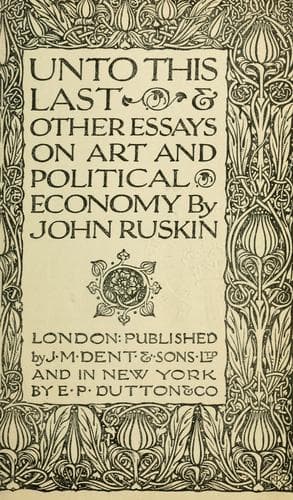
Unto This Last, and Other Essays on Political EconomyRuskin, John
General
Unto This Last, and Other Essays on Political Economy
Ruskin, John
Art; Economics
The currency of any country consists of every document acknowledging
debt which is transferable in the country.
This transferableness depends upon its intelligibility and credit. Its
intelligibility depends chiefly on the difficulty of forging anything
like it;--its credit much on national character, but ultimately always
on the existence of substantial means of meeting its demand.
As the degrees of transferableness are variable (some documents
passing only in certain places, and others passing, if at all, for
less than their inscribed value), both the mass and, so to speak,
fluidity, of the currency, are variable. True or perfect currency
flows freely, like a pure stream; it becomes sluggish or stagnant in
proportion to the quantity of less transferable matter which mixes
with it, adding to its bulk, but diminishing its purity. Substances of
intrinsic value, such as gold, mingle also with the currency, and
increase, while they modify, its power; these are carried by it as
stones are carried by a torrent, sometimes momentarily impeding,
sometimes concentrating its force, but not affecting its purity.
These substances of intrinsic value may be also stamped or signed so
as to become acknowledgments of debt, and then become, so far as they
operate independently of their intrinsic value, part of the real
currency.
Deferring consideration of minor forms of currency, consisting of
documents bearing private signature, we will examine the principle of
legally authorized or national currency.
This, in its perfect condition, is a form of public acknowledgment of
debt, so regulated and divided that any person presenting a commodity
of tried worth in the public market, shall, if he please, receive in
exchange for it a document giving him claim for the return of its
equivalent, (1) in any place, (2) at any time, and (3) in any kind.
When currency is quite healthy and vital, the persons entrusted with
its management are always able to give on demand either--
A. The assigning document for the assigned quantity of goods. Or,
B. The assigned quantity of goods for the assigning document.
If they cannot give document for goods, the national exchange is at
fault.
If they cannot give goods for document, the national credit is at
fault.
The nature and power of the document are therefore to be examined
under the three relations which it bears to Place, Time, and Kind.
Public-domain text, read in full here on John Shaqi.
Reviews
Reviews
No reviews yet
Be the first to share your thoughts on this work.
Elsewhere in the archive
Join the Discussion
Join the discussion
Sign in to leave a comment or review.
Sign InorCreate an account