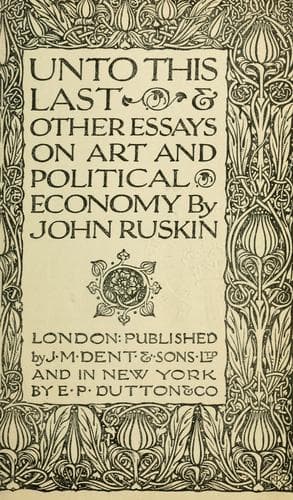
Unto This Last, and Other Essays on Political EconomyRuskin, John
General
Unto This Last, and Other Essays on Political Economy
Ruskin, John
Art; Economics
Now, the currency-holders always increase in number and influence in
proportion to the bluntness of nature and clumsiness of the
store-holders; for the less use people can make of things the more
they tire of them, and want to change them for something else, and
all frequency of change increases the quantity and power of currency;
while the large currency-holder himself is essentially a person who
never has been able to make up his mind as to what he will have, and
proceeds, therefore, in vague collection and aggregation, with more
and more infuriate passion, urged by complacency in progress, and
pride in conquest.
While, however, there is this obscurity in the nature of possession of
currency, there is a charm in the absoluteness of it, which is to some
people very enticing. In the enjoyment of real property others must
partly share. The groom has some enjoyment of the stud, and the
gardener of the garden; but the money is, or seems shut up; it is
wholly enviable. No one else can have part in any complacencies
arising from it.
The power of arithmetical comparison is also a great thing to
unimaginative people. They know always they are so much better than
they were, in money; so much better than others, in money; wit cannot
be so compared, nor character. My neighbour cannot be convinced I am
wiser than he is, but he can that I am worth so much more; and the
universality of the conviction is no less flattering than its
clearness. Only a few can understand, none measure, superiorities in
other things; but everybody can understand money, and count it.
Now, these various temptations to accumulation would be politically
harmless, if what was vainly accumulated had any fair chance of being
wisely spent. For as accumulation cannot go on for ever, but must some
day end in its reverse--if this reverse were indeed a beneficial
distribution and use, as irrigation from reservoir, the fever of
gathering, though perilous to the gatherer, might be serviceable to
the community. But it constantly happens (so constantly, that it may
be stated as a political law having few exceptions), that what is
unreasonably gathered is also unreasonably spent by the persons into
whose hands it finally falls. Very frequently it is spent in war, or
else in stupefying luxury, twice hurtful, both in being indulged by
the rich and witnessed by the poor. So that the _mal tener_ and _mal
dare_ are as correlative as complementary colours; and the circulation
of wealth, which ought to be soft, steady, strong, far-sweeping, and
full of warmth, like the Gulf Stream, being narrowed into an eddy, and
concentrated on a point, changes into the alternate suction and
surrender of Charybdis. Which is, indeed, I doubt not, the true
meaning of that marvellous fable, "infinite," as Bacon said of it,
"in matter of meditation."[96]
Public-domain text, read in full here on John Shaqi.
Reviews
Reviews
No reviews yet
Be the first to share your thoughts on this work.
Elsewhere in the archive
Join the Discussion
Join the discussion
Sign in to leave a comment or review.
Sign InorCreate an account