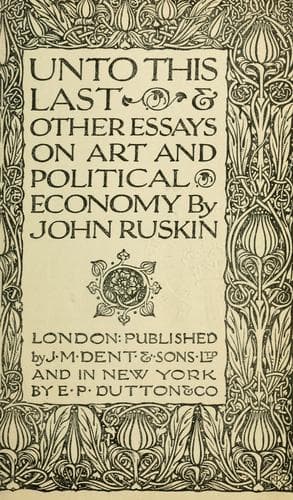
Unto This Last, and Other Essays on Political EconomyRuskin, John
General
Unto This Last, and Other Essays on Political Economy
Ruskin, John
Art; Economics
[96] It is a strange habit of wise humanity to speak in enigmas
only, so that the highest truths and usefullest laws must be
hunted for through whole picture-galleries of dreams, which
to the vulgar seem dreams only. Thus Homer, the Greek
tragedians, Plato, Dante, Chaucer, Shakespeare, and Goethe,
have hidden all that is chiefly serviceable in their work,
and in all the various literature they absorbed and
re-embodied, under types which have rendered it quite
useless to the multitude. What is worse, the two primal
declarers of moral discovery, Homer and Plato, are partly at
issue; for Plato's logical power quenched his imagination,
and he became incapable of understanding the purely
imaginative element either in poetry or painting; he
therefore somewhat overrates the pure discipline of
passionate art in song and music, and misses that of
meditative art. There is, however, a deeper reason for his
distrust of Homer. His love of justice, and reverently
religious nature made him dread as death, every form of
fallacy; but chiefly, fallacy respecting the world to come
(his own myths being only symbolic exponents of a rational
hope). We shall perhaps now every day discover more clearly
how right Plato was in this, and feel ourselves more and
more wonderstruck that men such as Homer and Dante (and, in
an inferior sphere, Milton), not to speak of the great
sculptors and painters of every age, have permitted
themselves, though full of all nobleness and wisdom, to coin
idle imaginations of the mysteries of eternity, and mould
the faiths of the families of the earth by the courses of
their own vague and visionary arts: while the indisputable
truths respecting human life and duty, respecting which they
all have but one voice, lie hidden behind these veils of
phantasy, unsought and often unsuspected. I will gather
carefully, out of Dante and Homer, what of this kind bears
on our subject, in its due place; the first broad intention
of their symbols may be sketched at once. The rewards of a
worthy use of riches, subordinate to other ends, are shown
by Dante in the fifth and sixth orbs of Paradise; for the
punishment of their unworthy use, three places are assigned;
one for the avaricious and prodigal whose souls are lost
("Hell": Canto 7); one for the avaricious and prodigal whose
souls are capable of purification ("Purgatory": Canto 19);
and one for the usurers, of whom none can be redeemed
("Hell": Canto 17). The first group, the largest in all hell
(gente piu che altrove troppa), meet in contrary currents,
as the waves of Charybdis, casting weights at each other
from opposite sides.
Public-domain text, read in full here on John Shaqi.
Reviews
Reviews
No reviews yet
Be the first to share your thoughts on this work.
Elsewhere in the archive
Join the Discussion
Join the discussion
Sign in to leave a comment or review.
Sign InorCreate an account