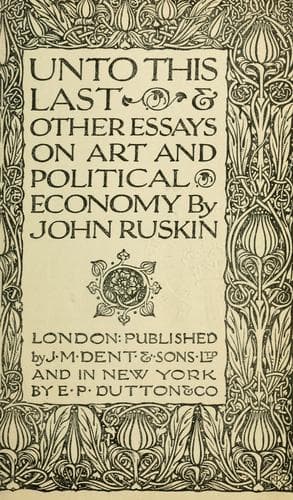
Unto This Last, and Other Essays on Political EconomyRuskin, John
General
Unto This Last, and Other Essays on Political Economy
Ruskin, John
Art; Economics
"Whom all that folk with such contention
Do flock about, my deare, my daughter is--
Honour and dignitie from her alone
Derived are."
By comparing Spenser's entire account of this Philotime with
Dante's of the Wealth-Siren, we shall get at the full
meaning of both poets; but that of Homer lies hidden much
more deeply. For his Sirens are indefinite, and they are
desires of any evil thing; power of wealth is not specially
indicated by him, until, escaping the harmonious danger of
imagination, Ulysses has to choose between two practical
ways of life, indicated by the two rocks of Scylla and
Charybdis. The monsters that haunt them are quite distinct
from the rocks themselves, which, having many other
subordinate significations, are in the main Labour and
Idleness, or getting and spending; each with its attendant
monster, or betraying demon. The rock of gaining has its
summit in the clouds, invisible and not to be climbed; that
of spending is low, but marked by the cursed fig-tree, which
has leaves but no fruit. We know the type elsewhere; and
there is a curious lateral allusion to it by Dante when
Jacopo di Sant' Andrea, who had ruined himself by profusion
and committed suicide, scatters the leaves of the bush of
Lotto degli Agli, endeavouring to hide himself among them.
We shall hereafter examine the type completely; here I will
only give an approximate rendering of Homer's words, which
have been obscured more by translation than even by
tradition--
"They are overhanging rocks. The great waves of blue water
break round them; and the blessed Gods call them the
Wanderers.
"By one of them no winged thing can pass--not even the wild
doves that bring ambrosia to their father Jove--but the
smooth rock seizes its sacrifice of them." (Not even
ambrosia to be had without Labour. The word is peculiar--as
a part of anything offered for sacrifice; especially used of
heave-offering.) "It reaches the wide heaven with its top,
and a dark-blue cloud rests on it, and never passes; neither
does the clear sky hold it in summer nor in harvest. Nor can
any man climb it--not if he had twenty feet and hands, for
it is smooth as though it were hewn.
Public-domain text, read in full here on John Shaqi.
Reviews
Reviews
No reviews yet
Be the first to share your thoughts on this work.
Elsewhere in the archive
Join the Discussion
Join the discussion
Sign in to leave a comment or review.
Sign InorCreate an account