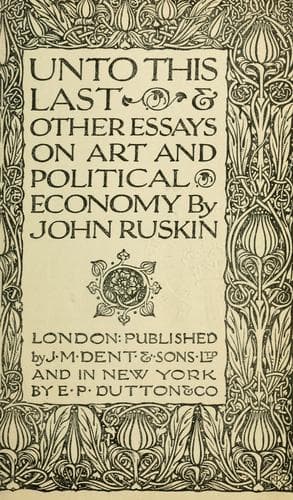
Unto This Last, and Other Essays on Political EconomyRuskin, John
General
Unto This Last, and Other Essays on Political Economy
Ruskin, John
Art; Economics
degrading--but always wonderful (she puts the stores on
board the ship invisibly, and is gone again, like a ghost);
even the wild beasts rejoice and are softened around her
cave; to men, she gives no rich feast, nothing but pure and
right nourishment,--Pramnian wine, cheese and flour; that is
corn, milk, and wine, the three great sustainers of life--it
is their own fault if these make swine of them; and swine
are chosen merely as the type of consumption; as Plato's
[Greek: huon polis] in the second book of the "Polity," and
perhaps chosen by Homer with a deeper knowledge of the
likeness of nourishment, and internal form of body. "Et quel
est, s'il vous plait, cet audacieux animal qui se permet
d'etre bati au dedans comme une jolie petite fille?"
"Helas! chere enfant, j'ai honte de le nommer, et il ne
foudra pas m'en vouloir. C'est ... c'est le cochon. Ce n'est
pas precisement flatteur pour vous; mais nous en sommes tous
la, et si cela vous contrarie par trop, il faut aller vous
plaindre au bon Dieu qui a voulu que les choses fussent
arrangees ainsi: seulement le cochon, qui ne pense qu' a
manger, a l'estomac bien plus vaste que nous, et c'est
toujours une consolation." ("Histoire d'une Bouchee de
Pain," Lettre ix.) But the deadly Sirens are all things
opposed to the Circean power. They promise pleasure, but
never give it. They nourish in no wise; but slay by slow
death. And whereas they corrupt the heart and the head,
instead of merely betraying the senses, there is no recovery
from their power; they do not tear nor snatch, like Scylla,
but the men who have listened to them are poisoned, and
waste away. Note that the Sirens' field is covered, not
merely with the bones, but with the skins of those who have
been consumed there. They address themselves, in the part of
the song which Homer gives, not to the passions of Ulysses,
but to his vanity, and the only man who ever came within
hearing of them, and escaped untempted, was Orpheus, who
silenced the vain imaginations by singing the praises of the
gods.
It is, then, one of these Sirens whom Dante takes as the
phantasm or deceitfulness of riches; but note further, that
she says it was her song that deceived Ulysses. Look back to
Dante's account of Ulysses' death, and we find it was not
the love of money, but pride of knowledge, that betrayed
him; whence we get the clue to Dante's complete meaning:
that the souls whose love of wealth is pardonable have been
first deceived into pursuit of it by a dream of its higher
uses, or by ambition. His Siren is therefore the Philotime
of Spenser, daughter of Mammon--
Public-domain text, read in full here on John Shaqi.
Reviews
Reviews
No reviews yet
Be the first to share your thoughts on this work.
Elsewhere in the archive
Join the Discussion
Join the discussion
Sign in to leave a comment or review.
Sign InorCreate an account