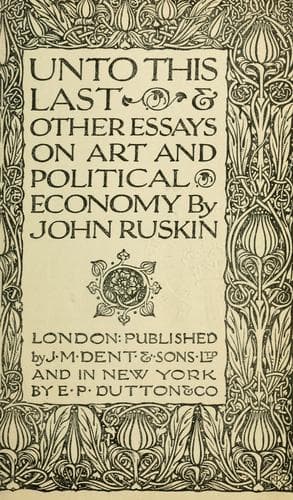
Unto This Last, and Other Essays on Political EconomyRuskin, John
General
Unto This Last, and Other Essays on Political Economy
Ruskin, John
Art; Economics
It has just been said, that the first great secret is to produce work
that will last. Now, the conditions of work lasting are twofold: it
must not only be in materials that will last, but it must be itself of
a quality that will last--it must be good enough to bear the test of
time. If it is not good, we shall tire of it quickly, and throw it
aside--we shall have no pleasure in the accumulation of it. So that
the first question of a good art-economist respecting any work is,
Will it lose its flavour by keeping? It may be very amusing now, and
look much like a work of genius. But what will be its value a hundred
years hence?
You cannot always ascertain this. You may get what you fancy to be
work of the best quality, and yet find to your astonishment that it
won't keep. But of one thing you may be sure, that art which is
produced hastily will also perish hastily; and that what is cheapest
to you now, is likely to be dearest in the end.
I am sorry to say, the great tendency of this age is to expend its
genius in perishable art of this kind, as if it were a triumph to burn
its thoughts away in bonfires. There is a vast quantity of intellect
and of labour consumed annually in our cheap illustrated publications;
you triumph in them; and you think it is so grand a thing to get so
many woodcuts for a penny. Why, woodcuts, penny and all, are as much
lost to you as if you had invested your money in gossamer. More lost,
for the gossamer could only tickle your face, and glitter in your
eyes; it could not catch your feet and trip you up: but the bad art
can, and does; for you can't like good woodcuts as long as you look at
the bad ones. If we were at this moment to come across a Titian
woodcut, or a Durer woodcut, we should not like it--those of us at
least who are accustomed to the cheap work of the day. We don't like,
and can't like, _that_ long; but when we are tired of one bad cheap
thing, we throw it aside and buy another bad cheap thing; and so keep
looking at bad things all our lives. Now, the very men who do all that
quick bad work for us are capable of doing perfect work. Only, perfect
work can't be hurried, and therefore it can't be cheap beyond a
certain point. But suppose you pay twelve times as much as you do now,
and you have one woodcut for a shilling instead of twelve; and the one
woodcut for a shilling is as good as art can be, so that you will
never tire of looking at it; and is struck on good paper with good
ink, so that you will never wear it out by handling it; while you are
sick of your penny-each cuts by the end of the week, and have torn
them mostly in half too. Isn't your shilling's worth the best bargain?
Public-domain text, read in full here on John Shaqi.
Reviews
Reviews
No reviews yet
Be the first to share your thoughts on this work.
Join the Discussion
Join the discussion
Sign in to leave a comment or review.
Sign InorCreate an account