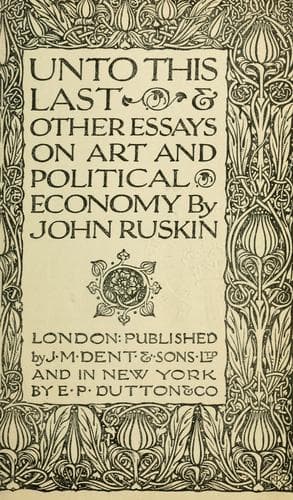
Unto This Last, and Other Essays on Political EconomyRuskin, John
General
Unto This Last, and Other Essays on Political Economy
Ruskin, John
Art; Economics
Commerce is necessary, however, not only to exchange local products,
but local skill. Labour requiring the agency of fire can only be given
abundantly in cold countries; labour requiring suppleness of body and
sensitiveness of touch only in warm ones; labour involving accurate
vivacity of thought only in temperate ones; while peculiar imaginative
actions are produced by extremes of heat and cold, and of light and
darkness. The production of great art is limited to climates warm
enough to admit of repose in the open air, and cool enough to render
such repose delightful. Minor variations in modes of skill distinguish
every locality. The labour which at any place is easiest, is in that
place cheapest; and it becomes often desirable that products raised in
one country should be wrought in another. Hence have arisen
discussions on "International values," which will be one day
remembered as highly curious exercises of the human mind. For it will
be discovered, in due course of tide and time, that international
value is regulated just as inter-provincial or inter-parishional value
is. Coals and hops are exchanged between Northumberland and Kent on
absolutely the same principles as iron and wine between Lancashire and
Spain. The greater breadth of an arm of the sea increases the cost,
but does not modify the principle of exchange; and a bargain written
in two languages will have no other economical results than a bargain
written in one. The distances of nations are measured not by seas, but
by ignorances; and their divisions determined, not by dialects, but by
enmities.
Of course, a system of international values may always be constructed
if we assume a relation of moral law to physical geography; as, for
instance, that it is right to cheat across a river, though not across
a road; or across a lake, though not across a river; or over a
mountain, though not across a lake, etc.:--again, a system of such
values may be constructed by assuming similar relations of taxation to
physical geography; as, for instance, that an article should be taxed
in crossing a river, but not in crossing a road; or in being carried
over a mountain, but not over a ferry, etc.: such positions are indeed
not easily maintained when once put in logical form; but one law of
international value is maintainable in any form; namely, that the
farther your neighbour lives from you, and the less he understands
you, the more you are bound to be true in your dealings with him;
because your power over him is greater in proportion to his ignorance,
and his remedy more difficult in proportion to his distance.
Public-domain text, read in full here on John Shaqi.
Reviews
Reviews
No reviews yet
Be the first to share your thoughts on this work.
Elsewhere in the archive
Join the Discussion
Join the discussion
Sign in to leave a comment or review.
Sign InorCreate an account