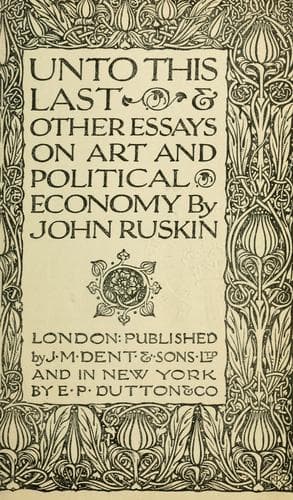
Unto This Last, and Other Essays on Political EconomyRuskin, John
General
Unto This Last, and Other Essays on Political Economy
Ruskin, John
Art; Economics
I have just said the breadth of sea increases the cost of exchange.
Exchange or commerce, as such, is always costly; the sum of the value
of the goods being diminished by the cost of their conveyance, and by
the maintenance of the persons employed in it. So that it is only when
there is advantage to both producers (in getting the one thing for the
other), greater than the loss in conveyance, that the exchange is
expedient. And it is only justly conducted when the porters kept by
the producers (commonly called merchants) look only for pay, and not
for profit. For in just commerce there are but three parties--the two
persons or societies exchanging and the agent or agents of exchange:
the value of the things to be exchanged is known by both the
exchangers, and each receives equivalent value, neither gaining nor
losing (for whatever one gains the other loses). The intermediate
agent is paid an equal and known percentage by both, partly for labour
in conveyance, partly for care, knowledge, and risk; every attempt at
concealment of the amount of the pay indicates either effort on the
part of the agent to obtain exorbitant percentage, or effort on the
part of the exchangers to refuse him a just one. But for the most part
it is the first, namely, the effort on the part of the merchant to
obtain larger profit (so called) by buying cheap and selling dear.
Some part, indeed, of this larger gain is deserved, and might be
openly demanded, because it is the reward of the merchant's knowledge,
and foresight of probable necessity; but the greater part of such gain
is unjust; and unjust in this most fatal way, that it depends first on
keeping the exchangers ignorant of the exchange value of the articles,
and secondly, on taking advantage of the buyer's need and the seller's
poverty. It is, therefore, one of the essential, and quite the most
fatal, forms of usury; for usury means merely taking an exorbitant sum
for the use of anything, and it is no matter whether the exorbitance
is on loan or exchange, in rent or in price--the essence of the usury
being that it is obtained by advantage of opportunity or necessity,
and not as due reward for labour. All the great thinkers, therefore,
have held it to be unnatural and impious, in so far as it feeds on
the distress of others, or their folly.[97] Nevertheless attempts to
repress it by law (in other words, to regulate prices by law so far as
their variations depend on iniquity, and not on nature) must for ever
be ineffective; though Plato, Bacon, and the First Napoleon--all three
of them men who knew somewhat more of humanity than the "British
merchant" usually does--tried their hands at it, and have left some
(probably) good moderative forms of law, which we will examine in
their place. But the only final check upon it must be radical
purifying of the national character, for being, as Bacon calls it,
"concessum propter duritiem cordis," it is to be done away with by
Public-domain text, read in full here on John Shaqi.
Reviews
Reviews
No reviews yet
Be the first to share your thoughts on this work.
Elsewhere in the archive
Join the Discussion
Join the discussion
Sign in to leave a comment or review.
Sign InorCreate an account