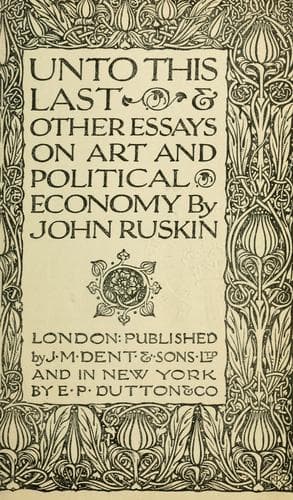
Unto This Last, and Other Essays on Political EconomyRuskin, John
General
Unto This Last, and Other Essays on Political Economy
Ruskin, John
Art; Economics
touching the heart only; not, however, without medicinal law--as in
the case of the other permission, "propter duritiem." But in this,
more than in anything (though much in all, and though in this he would
not himself allow of their application, for his own laws against usury
are sharp enough), Plato's words are true in the fourth book of the
"Polity," that neither drugs, nor charms, nor burnings, will touch a
deep-lying political sore, any more than a deep bodily one; but only
right and utter change of constitution; and that "they do but lose
their labour who think that by any tricks of law they can get the
better of these mischiefs of intercourse, and see not that they hew at
a Hydra."
[97] Hence Dante's companionship of Cahors, Inf., canto xi.,
supported by the view taken of the matter throughout the
middle ages, in common with the Greeks.
And indeed this Hydra seems so unslayable, and sin sticks so fast
between the joinings of the stones of buying and selling, that "to
trade" in things, or literally "cross-give" them, has warped itself,
by the instinct of nations, into their worst word for fraud; for,
because in trade there cannot but be trust, and it seems also that
there cannot but also be injury in answer to it, what is merely fraud
between enemies becomes treachery among friends: and "trader,"
"traditor," and "traitor" are but the same word. For which simplicity
of language there is more reason than at first appears; for as in true
commerce there is no "profit," so in true commerce there is no "sale."
The idea of sale is that of an interchange between enemies
respectively endeavouring to get the better of one another; but
commerce is an exchange between friends; and there is no desire but
that it should be just, any more than there would be between members
of the same family. The moment there is a bargain over the pottage,
the family relation is dissolved;--typically "the days of mourning for
my father are at hand." Whereupon follows the resolve "then will I
slay my brother."
Public-domain text, read in full here on John Shaqi.
Reviews
Reviews
No reviews yet
Be the first to share your thoughts on this work.
Elsewhere in the archive
Join the Discussion
Join the discussion
Sign in to leave a comment or review.
Sign InorCreate an account