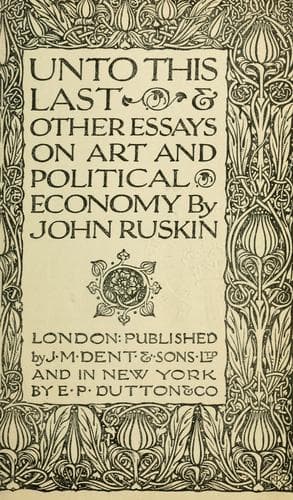
Unto This Last, and Other Essays on Political EconomyRuskin, John
General
Unto This Last, and Other Essays on Political Economy
Ruskin, John
Art; Economics
[98] Shakespeare would certainly never have chosen this name had
he been forced to retain the Roman spelling. Like Perdita,
"lost lady," or "Cordelia," "heart-lady," Portia is
"fortune-lady." The two great relative groups of words,
Fortune, fero, and fors--Portio, porto, and pars (with the
lateral branch, op-portune, im-portune, opportunity, etc.),
are of deep and intrinsic significance; their various senses
of bringing, abstracting, and sustaining, being all
centralized by the wheel (which bears and moves at once), or
still better, the ball (spera) of Fortune,--"Volve sua
spera, e beata si gode:" the motive power of this wheel
distinguishing its goddess from the fixed majesty of
Necessitas with her iron nails; or [Greek: ananke], with
her pillar of fire and iridescent orbits, fixed at the
centre. Portus and porta, and gate in its connexion with
gain, form another interesting branch group; and Mors, the
concentration of delaying, is always to be remembered with
Fors, the concentration of bringing and bearing, passing on
into Fortis and Fortitude.
[99] Out of whose mouths, indeed, no peace was ever promulgated,
but only equipoise of panic, highly tremulous on the edge in
changes in the wind.
With the usual tendency of long-repeated thought to take the surface
for the deep, we have conceived their goddesses as if they only gave
loveliness to gesture; whereas their true function is to give
graciousness to deed, the other loveliness arising naturally out of
that. In which function Charis becomes Charitas[100] and has a name and
praise even greater than that of Faith or truth, for these may be
maintained sullenly and proudly; but Charis[101] is in her countenance
always gladdening (Aglaia), and in her service instant and humble; and
the true wife of Vulcan, or Labour. And it is not until her sincerity
of function is lost, and her mere beauty contemplated, instead of her
patience, that she is born again of the foam flake, and becomes
Aphrodite; then only capable of joining herself to War and to the
enmities of men, instead of to Labour and their services. Therefore
the fable of Mars and Venus is, chosen by Homer, picturing himself as
Demodocus, to sing at the games in the Court of Alcinous. Phaeacia is
the Homeric island of Atlantis; an image of noble and wise government,
concealed, how slightly! merely by the change of a short vowel for a
long one in the name of its queen; yet misunderstood by all later
writers, even by Horace in his "pinguis, Phaeaxque," etc. That fable
expresses the perpetual error of men, thinking that grace and dignity
can only be reached by the soldier, and never by the artizan; so that
commerce and the useful arts have had the honour and beauty taken
away, and only the Fraud[102] and Pain left to them, with the lucre.
Public-domain text, read in full here on John Shaqi.
Reviews
Reviews
No reviews yet
Be the first to share your thoughts on this work.
Elsewhere in the archive
Join the Discussion
Join the discussion
Sign in to leave a comment or review.
Sign InorCreate an account