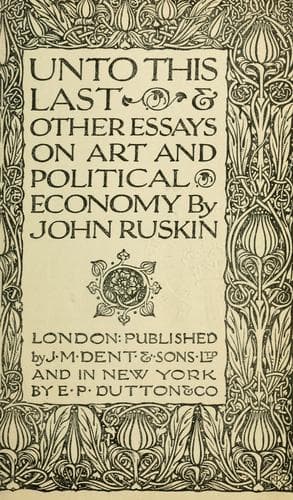
Unto This Last, and Other Essays on Political EconomyRuskin, John
General
Unto This Last, and Other Essays on Political Economy
Ruskin, John
Art; Economics
Which is, indeed, one great reason of the continual blundering about
the offices of government with respect to commerce. The higher classes
are ashamed to deal with it; and though ready enough to fight for (or
occasionally against) the people,--to preach to them,--or judge them,
will not break bread for them; the refined upper servant who has
willingly looked after the burnishing of the armoury and ordering of
the library, not liking to set foot into the larder.
[100] The reader must not think that any care can be misspent
in tracing the connexion and power of the words which we
have to use in the sequel. Not only does all soundness of
reasoning depend on the work thus done in the outset, but
we may sometimes gain more by insistence on the expression
of a truth, than by much wordless thinking about it; for
to strive to express it clearly is often to detect it
thoroughly; and education, even as regards thought, nearly
sums itself in making men economise their words, and
understand them. Nor is it possible to estimate the harm
that has been done, in matters of higher speculation and
conduct, by loose verbiage, though we may guess at it by
observing the dislike which people show to having anything
about their religion said to them in simple words, because
then they understand it. Thus congregations meet weekly to
invoke the influence of a Spirit of Life and Truth; yet if
any part of that character were intelligibly expressed to
them by the formulas of the service, they would be offended.
Suppose, for instance, in the closing benediction, the
clergyman were to give its vital significance to the word
"Holy," and were to say, "the Fellowship of the Helpful and
Honest Ghost be with you, and remain with you always," what
would be the horror of many, first, at the irreverence of so
intelligible an expression, and, secondly, at the
discomfortable entry of the suspicion that (while throughout
the commercial dealings of the week they had denied the
propriety of Help, and possibility of Honesty) the Person
whose company they had been asking to be blessed with could
have no fellowship with knaves.
[101] As Charis becomes Charitas [see next page], the word "Cher,"
or "Dear," passes from Shylock's sense of it (to buy cheap
and sell dear) into Antonio's sense of it: emphasized with
the final i in tender "Cheri," and hushed to English
calmness in our noble "Cherish."
Public-domain text, read in full here on John Shaqi.
Reviews
Reviews
No reviews yet
Be the first to share your thoughts on this work.
Elsewhere in the archive
Join the Discussion
Join the discussion
Sign in to leave a comment or review.
Sign InorCreate an account