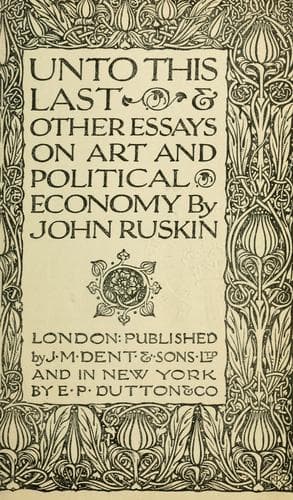
Unto This Last, and Other Essays on Political EconomyRuskin, John
General
Unto This Last, and Other Essays on Political Economy
Ruskin, John
Art; Economics
generally rangeable under the two qualities of lordly (or tending
towards rule, construction, and harmony) and servile (or tending
towards misrule, destruction, and discord); and, since the lordly part
is only in a state of profitableness while ruling, and the servile
only in a state of redeemableness while serving, the whole health of
the state depends on the manifest separation of these two elements of
its mind: for, if the servile part be not separated and rendered
visible in service, it mixes with and corrupts the entire body of the
state; and if the lordly part be not distinguished, and set to rule,
it is crushed and lost, being turned to no account, so that the rarest
qualities of the nation are all given to it in vain.[106] The
effecting of which distinction is the first object, as we shall see
presently, of national councils.
[104] "The ordinary brute, who flourishes in the very centre
of ornate life, tells us of unknown depths on the verge of
which we totter, being bound to thank our stars every day we
live that there is not a general outbreak and a revolt from
the yoke of civilization."--_Times_ leader, Dec. 25th, 1862.
Admitting that our stars are to be thanked for our safety,
whom are we to thank for the danger?
[105] Our politicians, even the best of them, regard only the
distress caused by the failure of mechanical labour. The
degradation caused by its excess is a far more serious
subject of thought, and of future fear. I shall examine this
part of our subject at length hereafter. There can hardly be
any doubt, at present, cast on the truth of the above
passages, as all the great thinkers are unanimous on the
matter. Plato's words are terrific in their scorn and pity
whenever he touches on the mechanical arts. He calls the men
employed in them not even human,--but partially and
diminutively human, "[Greek: anthropiskoi]," and opposes
such work to noble occupations, not merely as prison is
opposed to freedom, but as a convict's dishonoured prison is
to the temple (escape from them being like that of a
criminal to the sanctuary), and the destruction caused by
them being of soul no less than body.--Rep., vi. 9. Compare
"Laws," v. 11. Xenophon dwells on the evil of occupations at
the furnace (root of [Greek: banausos]), and especially their
"[Greek: ascholia], want of leisure"--Econ. i. 4. (Modern
England, with all its pride of education, has lost that
first sense of the word "school," and till it recover that
it will find no other rightly.) His word for the harm to the
soul is to "break" it, as we say of the heart.--Econ. i. 6.
And herein also is the root of the scorn, otherwise
apparently most strange and cruel, with which Homer, Dante,
Public-domain text, read in full here on John Shaqi.
Reviews
Reviews
No reviews yet
Be the first to share your thoughts on this work.
Elsewhere in the archive
Join the Discussion
Join the discussion
Sign in to leave a comment or review.
Sign InorCreate an account