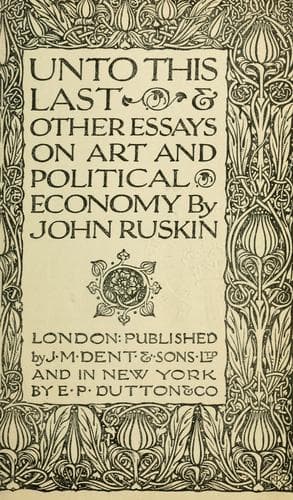
Unto This Last, and Other Essays on Political EconomyRuskin, John
General
Unto This Last, and Other Essays on Political Economy
Ruskin, John
Art; Economics
"Custom hangs upon us with a weight
Heavy as frost, and deep almost as life."
This power and depth are, however, just what give value to custom,
when it works with life, instead of against it.
The high ethical training, of a nation being threefold, of body,
heart, and practice (compare the statement in the preface to "Unto
This Last"), involves exquisiteness in all its perceptions of
circumstance,--all its occupations of thought. It implies perfect
Grace, Pitifulness, and Peace; it is irreconcilably inconsistent with
filthy or mechanical employments,--with the desire of money,--and with
mental states of anxiety, jealousy, and indifference to pain. The
present insensibility of the upper classes of Europe to the aspects of
suffering, uncleanness, and crime, binds them not only into one
responsibility with the sin, but into one dishonour with the foulness,
which rot at their thresholds. The crimes daily recorded in the police
courts of London and Paris (and much more those which are unrecorded)
are a disgrace to the whole body politic;[104] they are, as in the
body natural, stains of disease on a face of delicate skin, making the
delicacy itself frightful. Similarly, the filth and poverty permitted
or ignored in the midst of us are as dishonourable to the whole social
body, as in the body natural it is to wash the face, but leave the
hands and feet foul. Christ's way is the only true one: begin at the
feet; the face will take care of itself. Yet, since necessarily, in
the frame of a nation, nothing but the head can be of gold, and the
feet, for the work they have to do, must be part of iron, part of
clay;--foul or mechanical work is always reduced by a noble race to
the minimum in quantity; and, even then, performed and endured, not
without sense of degradation, as a fine temper is wounded by the sight
of the lower offices of the body. The highest conditions of human
society reached hitherto, have cast such work to slaves;--supposing
slavery of a politically defined kind to be done away with, mechanical
and foul employment must in all highly-organized states take the
aspect either of punishment or probation. All criminals should at once
be set to the most dangerous and painful forms of it, especially to
work in mines and at furnaces,[105] so as to relieve the innocent
population as far as possible: of merely rough (not mechanical) manual
labour, especially agricultural, a large portion should be done by the
upper classes;--bodily health, and sufficient contrast and repose for
the mental functions, being unattainable without it; what necessarily
inferior labour remains to be done, as especially in manufactures,
should, and always will, when the relations of society are reverent
and harmonious, fall to the lot of those who, for the time, are fit
for nothing better. For as, whatever the perfectness of the
educational system, there must remain infinite differences between the
natures and capacities of men; and these differing natures are
Public-domain text, read in full here on John Shaqi.
Reviews
Reviews
No reviews yet
Be the first to share your thoughts on this work.
Elsewhere in the archive
Join the Discussion
Join the discussion
Sign in to leave a comment or review.
Sign InorCreate an account