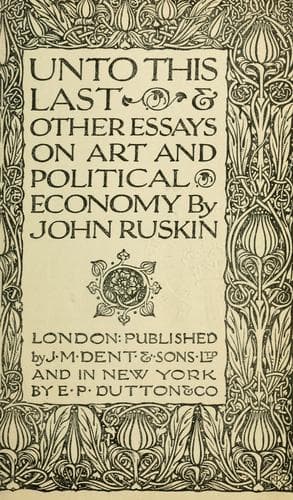
Unto This Last, and Other Essays on Political EconomyRuskin, John
General
Unto This Last, and Other Essays on Political Economy
Ruskin, John
Art; Economics
[109] Two curious economical questions arise laterally with
respect to this branch of law, namely, the cost of crime and
the cost of judgment. The cost of crime is endured by
nations ignorantly, not being clearly stated in their
budgets; the cost of judgment patiently (provided only it
can be had pure for the money), because the science, or
perhaps we ought rather to say the art, of law, is felt to
found a noble profession, and discipline; so that civilized
nations are usually glad that a number of persons should be
supported by funds devoted to disputation and analysis. But
it has not yet been calculated what the practical value
might have been, in other directions, of the intelligence
now occupied in deciding, through courses of years, what
might have been decided as justly, had the date of judgment
been fixed, in as many hours. Imagine one half of the funds
which any great nation devotes to dispute by law, applied to
the determination of physical questions in medicine,
agriculture, and theoretic science; and calculate the
probable results within the next ten years.
I say nothing yet, of the more deadly, more lamentable loss,
involved in the use of purchased instead of personal
justice,--[Greek: epakto par' allon--aporia' oikeion].
Therefore, in order to true analysis of it, we must understand the
real meaning of this word "injury."
We commonly understand by it any kind of harm done by one man to
another; but we do not define the idea of harm; sometimes we limit it
to the harm which the sufferer is conscious of, whereas much the worst
injuries are those he is unconscious of; and, at other times, we limit
the idea to violence, or restraint, whereas much the worse forms of
injury are to be accomplished by carelessness, and the withdrawal of
restraint.
"Injury" is, then, simply the refusal, or violation of any man's right
or claim upon his fellows: which claim, much talked of in modern
times, under the term "right," is mainly resolvable into two branches:
a man's claim not to be hindered from doing what he should; and his
claim to be hindered from doing what he should not; these two forms of
hindrance being intensified by reward, or help and fortune, or Fors on
one side, and punishment, impediment, and even final arrest, or Mors,
on the other.
Public-domain text, read in full here on John Shaqi.
Reviews
Reviews
No reviews yet
Be the first to share your thoughts on this work.
Elsewhere in the archive
Join the Discussion
Join the discussion
Sign in to leave a comment or review.
Sign InorCreate an account