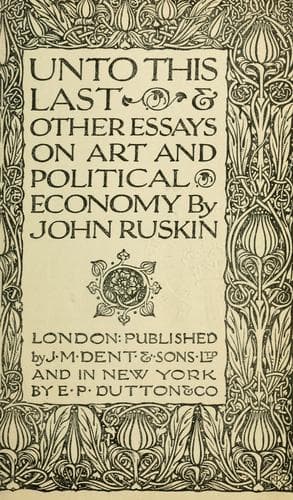
Unto This Last, and Other Essays on Political EconomyRuskin, John
General
Unto This Last, and Other Essays on Political Economy
Ruskin, John
Art; Economics
Every article of human wealth has certain conditions attached to its
merited possession, which, when they are unobserved, possession
becomes rapine. The object of meristic law is not only to secure every
man his rightful share (the share, that is, which he has worked for,
produced, or received by gift from a rightful owner), but to enforce
the due conditions of possession, as far as law may conveniently
reach; for instance, that land shall not be wantonly allowed to run to
waste, that streams shall not be poisoned by the persons through whose
properties they pass, nor air be rendered unwholesome beyond given
limits. Laws of this kind exist already in rudimentary degree, but
needing large development; the just laws respecting the possession of
works of art have not hitherto been so much as conceived, and the
daily loss of national wealth, and of its use, in this respect, is
quite incalculable.[108] While, finally, in certain conditions of a
nation's progress, laws limiting accumulation of property may be found
expedient.
[108] These laws need revision quite as much respecting property
in national as in private hands. For instance: the public
are under a vague impression, that because they have paid
for the contents of the British Museum, every one has an
equal right to see and to handle them. But the public have
similarly paid for the contents of Woolwich Arsenal; yet do
not expect free access to it, or handling of its contents.
The British Museum is neither a free circulating library,
nor a free school; it is a place for the safe preservation,
and exhibition on due occasion, of unique books, unique
objects of natural history, and unique works of art; its
books can no more be used by everybody than its coins can be
handled, or its statues cast. Free libraries there ought to
be in every quarter of London, with large and complete
reading-rooms attached; so also free educational
institutions should be open in every quarter of London, all
day long and till late at night, well lighted, well
catalogued, and rich in contents both of art and natural
history. But neither the British Museum nor National Gallery
are schools; they are treasuries; and both should be
severely restricted in access and in use. Unless some order
is taken, and that soon, in the MSS. department of the
Museum (Sir Frederic Madden was complaining of this to me
only the other day), the best MSS. in the collection will be
destroyed, irretrievably, by the careless and continual
handling to which they are now subjected.
Critic law determines questions of injury, and assigns due rewards and
punishments to conduct.[109]
Public-domain text, read in full here on John Shaqi.
Reviews
Reviews
No reviews yet
Be the first to share your thoughts on this work.
Elsewhere in the archive
Join the Discussion
Join the discussion
Sign in to leave a comment or review.
Sign InorCreate an account