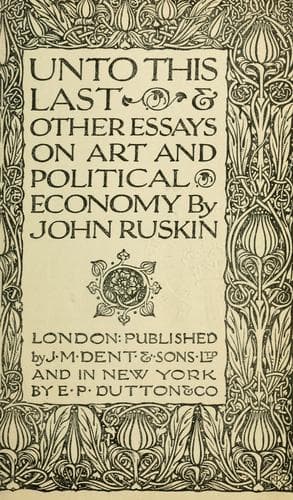
Unto This Last, and Other Essays on Political EconomyRuskin, John
General
Unto This Last, and Other Essays on Political Economy
Ruskin, John
Art; Economics
I say "follow," but in reality they are the recognition. Reverence is
but the perceiving of the thing in its entire truth: truth reverted is
truth revered (vereor and veritas having clearly the same root), so
that Goethe is for once, and for a wonder, wrong in that part of the
noble scheme of education in "Wilhelm Meister," in which he says that
reverence is not innate, and must be taught. Reverence is as
instinctive as anger;--both of them instant on true vision: it is
sight and understanding that we have to teach, and these are
reverence. Make a man perceive worth, and in its reflection he sees
his own relative unworth, and worships thereupon inevitably, not with
stiff courtesy, but rejoicingly, passionately, and, best of all,
restfully: for the inner capacity of awe and love is infinite in man;
and when his eyes are once opened to the sight of beauty and honour,
it is with him as with a lover, who, falling at his mistress's feet,
would cast himself through the earth, if it might be, to fall lower,
and find a deeper and humbler place. And the common insolences and
petulances of the people, and their talk of equality, are not
irreverence in them in the least, but mere blindness, stupefaction,
and fog in the brains,[110] which pass away in the degree that they
are raised and purified: the first sign of which raising is, that they
gain some power of discerning, and some patience in submitting to
their true counsellors and governors; the modes of such discernment
forming the real "constitution" of the state, and not the titles or
offices of the discerned person; for it is no matter, save in degree
of mischief, to what office a man is appointed, if he cannot fulfil
it. And this brings us to the third division of our subject.
[110] Compare Chaucer's "villany" (clownishness).
"Full foul and chorlishe seemed she,
And eke villanous for to be,
And little coulde of norture
To worship any creature."
III.--GOVERNMENT BY COUNCIL.
This is the determination, by living authority, of the national
conduct to be observed under existing circumstances; and the
modification or enlargement, abrogation or enforcement, of the code of
national law according to present needs or purposes. This government
is necessarily always by Council, for though the authority of it may
be vested in one person, that person cannot form any opinion on a
matter of public interest but by (voluntarily or involuntarily)
submitting himself to the influence of others.
This government is always twofold--visible and invisible.
Public-domain text, read in full here on John Shaqi.
Reviews
Reviews
No reviews yet
Be the first to share your thoughts on this work.
Elsewhere in the archive
Join the Discussion
Join the discussion
Sign in to leave a comment or review.
Sign InorCreate an account