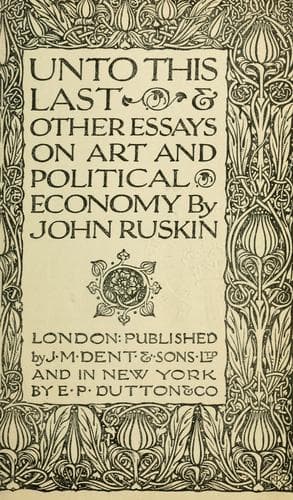
Unto This Last, and Other Essays on Political EconomyRuskin, John
General
Unto This Last, and Other Essays on Political Economy
Ruskin, John
Art; Economics
The visible government is that which nominally carries on the national
business; determines its foreign relations, raises taxes, levies
soldiers, fights battles, or directs that they be fought, and
otherwise becomes the exponent of the national fortune. The invisible
government is that exercised by all energetic and intelligent men,
each in his sphere, regulating the inner will and secret ways of the
people, essentially forming its character, and preparing its fate.
Visible governments are the toys of some nations, the diseases of
others, the harness of some, the burdens of the more, the necessity of
all. Sometimes their career is quite distinct from that of the people,
and to write it, as the national history, is as if one should number
the accidents which befall a man's weapons and wardrobe, and call the
list his biography. Nevertheless a truly noble and wise nation
necessarily has a noble and wise visible government, for its wisdom
issues in that conclusively. "Not out of the oak, nor out of the rock,
but out of the temper of man, is his polity:" where the temper
inclines, it inclines as Samson by his pillar, and draws all down with
it.
Visible governments are, in their agencies, capable of three pure
forms, and of no more than three.
They are either monarchies, where the authority is vested in one
person; oligarchies, when it is vested in a minority; or democracies,
when vested in a majority.
But these three forms are not only, in practice, variously limited and
combined, but capable of infinite difference in character and use,
receiving specific names according to their variations; which names,
being nowise agreed upon, nor consistently used, either in thought or
writing, no man can at present tell, in speaking of any kind of
government, whether he is understood, nor in hearing whether he
understands. Thus we usually call a just government by one person a
monarchy, and an unjust or cruel one, a tyranny; this might be
reasonable if it had reference to the divinity of true government; but
to limit the term "oligarchy" to government by a few rich people, and
to call government by a few wise or noble people "aristocracies," is
evidently absurd, unless it were proved that rich people never could
be wise, or noble people rich; and farther absurd because there are
other distinctions in character, as well as riches or wisdom (greater
purity of race, or strength of purpose, for instance), which may give
the power of government to the few. So that if we had to give names to
every group or kind of minority, we should have verbiage enough. But
there is one right name--"oligarchy."
Public-domain text, read in full here on John Shaqi.
Reviews
Reviews
No reviews yet
Be the first to share your thoughts on this work.
Elsewhere in the archive
Join the Discussion
Join the discussion
Sign in to leave a comment or review.
Sign InorCreate an account