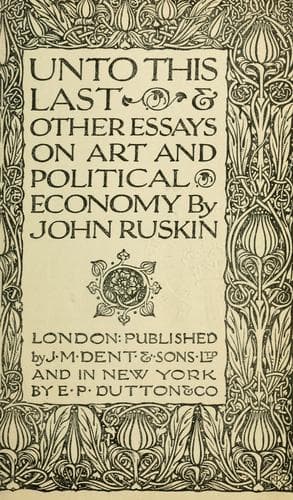
Unto This Last, and Other Essays on Political EconomyRuskin, John
General
Unto This Last, and Other Essays on Political Economy
Ruskin, John
Art; Economics
But whether governments be bad or good, one general disadvantage seems
to attach to them in modern times--that they are all costly. This,
however, is not essentially the fault of the governments. If nations
choose to play at war, they will always find their governments willing
to lead the game, and soon coming under that term of Aristophanes,
"[Greek: kapeloi aspidon]," shield-sellers. And when ([Greek: pem'
epipemati]) the shields take the form of iron ships, with apparatus
"for defence against liquid fire"--as I see by latest accounts they
are now arranging the decks in English dockyards,--they become costly
biers enough for the grey convoy of chief-mourner waves, wreathed with
funereal foam, to bear back the dead upon; the massy shoulders of
those corpse-bearers being intended for quite other work, and to bear
the living, if we would let them.
Nor have we the least right to complain of our governments being
expensive so long as we set the government to do precisely the work
which brings no return. If our present doctrines of political economy
be just, let us trust them to the utmost; take that war business out
of the government's hands, and test therein the principles of supply
and demand. Let our future sieges of Sebastopol be done by
contract--no capture, no pay--(I am prepared to admit that things
might go better so); and let us sell the commands of our prospective
battles, with our vicarages, to the lowest bidder; so may we have
cheap victories and divinity. On the other hand, if we have so much
suspicion of our science that we dare not trust it on military or
spiritual business, it would be but reasonable to try whether some
authoritative handling may not prosper in matters utilitarian. If we
were to set our governments to do useful things instead of
mischievous, possibly even the apparatus might in time come to be less
costly! The machine, applied to the building of the house, might
perhaps pay, when it seems not to pay, applied to pulling it down. If
we made in our dockyards ships to carry timber and coals, instead of
cannon, and with provision for brightening of domestic solid culinary
fire, instead of for the averting of hostile liquid fire, it might
have some effect on the taxes? Or if the iron bottoms were to bring us
home nothing better than ivory and peacocks, instead of martial glory,
we might at least have gayer suppers, and doors of the right material
for dreams after them. Or suppose that we tried the experiment on land
instead of water carriage; already the government, not unapproved,
carries letters and parcels for us; larger packages may in time
follow:--parcels;--even general merchandise? Why not, at last,
ourselves? Had the money spent in local mistakes and vain private
litigation, on the railroads of England, been laid out, instead, under
proper government restraint, on really useful railroad work, and had
no absurd expense been incurred in ornamenting stations, we might
Public-domain text, read in full here on John Shaqi.
Reviews
Reviews
No reviews yet
Be the first to share your thoughts on this work.
Elsewhere in the archive
Join the Discussion
Join the discussion
Sign in to leave a comment or review.
Sign InorCreate an account