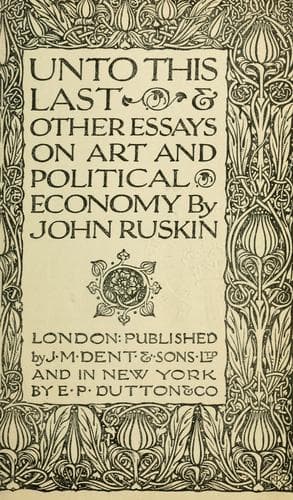
Unto This Last, and Other Essays on Political EconomyRuskin, John
General
Unto This Last, and Other Essays on Political Economy
Ruskin, John
Art; Economics
I have not, however, been able to ascertain in definite terms, from
the declaimers against slavery, what they understand by it. If they
mean only the imprisonment or compulsion being in many cases highly
expedient, slavery, so defined, would be no evil in itself, but only
in its abuse; that is, when men are slaves, who should not be, or
masters, who should not be, or under conditions which should not be.
It is not, for instance, a necessary condition of slavery, nor a
desirable one, that parents should be separated from children, or
husbands from wives; but the institution of war, against which people
declaim with less violence, effects such separations--not unfrequently
in a higher permanent manner. To press a sailor, seize a white youth
by conscription for a soldier, or carry off a black one for a
labourer, may all be right, or all wrong, according to needs and
circumstances. It is wrong to scourge a man unnecessarily. So it is to
shoot him. Both must be done on occasion; and it is better and kinder
to flog a man to his work, than to leave him idle till he robs, and
flog him afterwards. The essential thing for all creatures is to be
made to do right; how they are made to do it--by pleasant promises, or
hard necessities, pathetic oratory, or the whip, is comparatively
immaterial. To be deceived is perhaps as incompatible with human
dignity as to be whipped, and I suspect the last instrument to be not
the worst, for the help of many individuals. The Jewish nation throve
under it, in the hand of a monarch reputed not unwise; it is only the
change of whip for scorpion which is expedient, and yet that change is
as likely to come to pass on the side of licence as of law; for the
true scorpion whips are those of the nation's pleasant vices, which
are to it as St. John's locusts--crown on the head, ravin in the
mouth, and sting in the tail. If it will not bear the rule of Athena
and her brother, who shepherd without smiting ([Greek: ou plege
nemontes]), Athena at last calls no more in the corners of the
streets; and then follows the rule of Tisiphone, who smites without
shepherding.
Public-domain text, read in full here on John Shaqi.
Reviews
Reviews
No reviews yet
Be the first to share your thoughts on this work.
Elsewhere in the archive
Join the Discussion
Join the discussion
Sign in to leave a comment or review.
Sign InorCreate an account