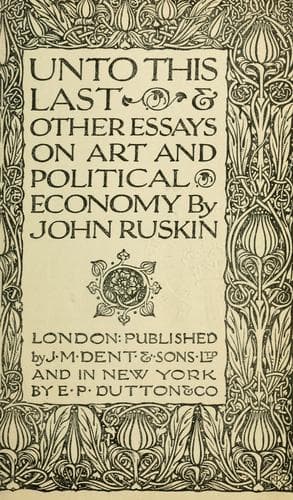
Unto This Last, and Other Essays on Political EconomyRuskin, John
General
Unto This Last, and Other Essays on Political Economy
Ruskin, John
Art; Economics
If, however, slavery, instead of absolute compulsion, is meant the
purchase, by money, of the right of compulsion, such purchase is
necessarily made whenever a portion of any territory is transferred,
for money, from one monarch to another: which has happened frequently
enough in history, without its being supposed that the inhabitants of
the districts so transferred became their slaves. In this, as in the
former case, the dispute seems about the fashion of the thing rather
than the fact of it. There are two rocks in mid-sea, on each of which,
neglected equally by instructive and commercial powers, a handful of
inhabitants live as they may. Two merchants bid for the two
properties, but not in the same terms. One bids for the people, buys
them, and sets them to work, under pain of scourge; the other bids for
the rock, buys it, and throws the inhabitants into the sea. The former
is the American, the latter the English method, of slavery; much is to
be said for, and something against, both, which I hope to say in due
time and place.
If, however, slavery mean not merely the purchase of the right of
compulsion, but the purchase of the body and soul of the creature
itself for money, it is not, I think, among the black races that
purchases of this kind are most extensively made, or that separate
souls of a fine make fetch the highest price. This branch of the
inquiry we shall have occasion also to follow out at some length; for
in the worst instance of the "[Greek: Bion prasis]" we are apt to get
only Pyrrhon's answer--[Greek: ti phes?--epriamen se? Adelon].
The fact is that slavery is not a political institution at all, but an
inherent, natural, and eternal inheritance of a large portion of the
human race--to whom the more you give of their own will, the more
slaves they will make themselves. In common parlance, we idly confuse
captivity with slavery, and are always thinking of the difference
between pine-trunks and cowslip bells, or between carrying wood and
clothes-stealing, instead of noting the far more serious differences
between Ariel and Caliban, and the means by which practically that
difference may be brought about.[114]
Public-domain text, read in full here on John Shaqi.
Reviews
Reviews
No reviews yet
Be the first to share your thoughts on this work.
Elsewhere in the archive
Join the Discussion
Join the discussion
Sign in to leave a comment or review.
Sign InorCreate an account