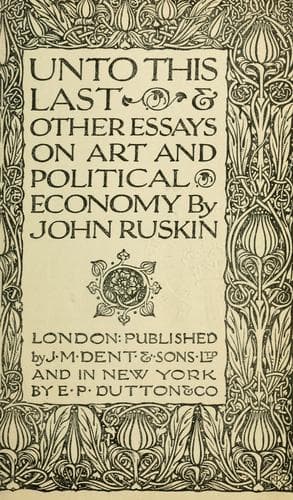
Unto This Last, and Other Essays on Political EconomyRuskin, John
General
Unto This Last, and Other Essays on Political Economy
Ruskin, John
Art; Economics
[114] The passage of Plato, referred to in note p. 280, in its
context, respecting the slave who, well dressed and washed,
aspires to the hand of his master's daughter, corresponds
curiously to the attack of Caliban on Prospero's cell, and
there is an undercurrent of meaning throughout, in the
"Tempest" as well as in the "Merchant of Venice"; referring
in this case to government, as in that to commerce. Miranda
("the wonderful," so addressed first by Ferdinand, "Oh, you
wonder!") corresponds to Homer's Arete: Ariel and Caliban
are respectively the spirits of freedom and mechanical
labour. Prospero ("for hope"), a true governor, opposed to
Sycorax, the mother of slavery, her name, "Swine-raven,"
indicating at once brutality and deathfulness; hence the
line--"As wicked dew as e'er my mother brushed, with raven's
feather,"--etc. For all dreams of Shakespeare, as those of
true and strong men must be, are "[Greek: phantasmata theia,
kai skiai ton onton]," phantasms of God, and shadows of
things that are. We hardly tell our children, willingly, a
fable with no purport in it; yet we think God sends His best
messengers only to say fairy tales to us, all fondness and
emptiness. The "Tempest" is just like a grotesque in a rich
missal, "clasped where paynims pray." Ariel is the spirit of
true liberty, in early stages of human society oppressed by
ignorance and wild tyranny; venting groans as fast as
mill-wheels strike; in shipwreck of states, fearful; so that
"all but mariners plunge in the brine, and quit the vessel,
then all afire with me," yet having in itself the will and
sweetness of truest peace, whence that is especially called
"Ariel's" song, "Come unto these yellow sands"--(fenceless,
and countless--changing with the sweep of the sea--"vaga
arena." Compare Horace's opposition of the sea-sand to the
dust of the grave: "numero carentis"--"exigui;" and again
compare "animo rotundum percurrisse" with "put a girdle
round the earth")--"and then take hands: court'sied when you
have, and kiss'd,--the wild waves whist:" (mind it is
"courtesia," not "curtsey") and read "quiet" for "whist" if
you want the full sense. Then may you indeed foot it featly,
and sweet spirits bear the burden for you--with watch in the
night, and call in early morning. The power of liberty in
elemental transformation follows--"Full fathom five thy
father lies, of his bones are coral made." Then, giving rest
after labour, it "fetches dew from the still-vex'd
Bermoothes, and, with a charm joined to their suffered
labour, leaves men asleep." Snatching away the feast of the
cruel, it seems to them as a harpy, followed by the utterly
Public-domain text, read in full here on John Shaqi.
Reviews
Reviews
No reviews yet
Be the first to share your thoughts on this work.
Elsewhere in the archive
Join the Discussion
Join the discussion
Sign in to leave a comment or review.
Sign InorCreate an account