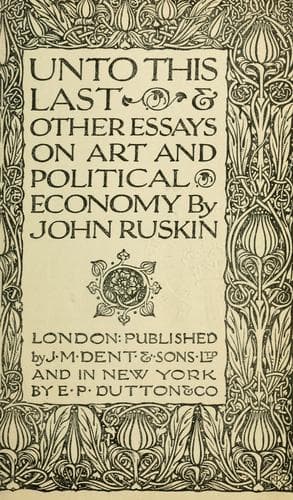
Unto This Last, and Other Essays on Political EconomyRuskin, John
General
Unto This Last, and Other Essays on Political Economy
Ruskin, John
Art; Economics
Supposing the rich to be entirely selfish, it is always for their
interest that the poor should be as numerous as they can employ and
restrain. For, granting the entire population no larger than the
ground can easily maintain,--that the classes are stringently
divided,--and that there is sense or strength of hand enough with the
rich to secure obedience; then, if nine-tenths of a nation are poor,
the remaining tenth have the service of nine persons each;[116] but,
if eight-tenths are poor, only of four each; if seven-tenths are poor,
of two and a third each; but, practically if the rich strive always to
obtain more power over the poor, instead of to raise them,--and if, on
the other hand, the poor become continually more vicious and numerous,
through neglect and oppression--though the range of the power of the
rich increases, its tenure becomes less secure; until, at last, the
measure of iniquity being full, revolution, civil war, or the
subjection of the state to a healthier or stronger one, closes the
moral corruption and industrial disease.
[116] I say nothing yet of the quality of the servants, which,
nevertheless, is the gist of the business. Will you have
Paul Veronese to paint your ceiling, or the plumber from
over the way? Both will work for the same money; Paul, if
anything, a little cheaper of the two, if you keep him in
good humour; only you have to discern him first, which will
need eyes.
It is rare, however, that things come to this extremity. Kind persons
among the rich, and wise among the poor, modify the connexion of the
classes: the efforts made to raise and relieve on the one side, and
the success and honest toil on the other, bind and blend the orders of
society into the confused tissue of half-felt obligation,
sullenly-rendered obedience, and variously-directed, or mis-directed,
toil, which form the warp of daily life. But this great law rules all
the wild design of the weaving; that success (while society is guided
by laws of competition) signifies always so much victory over your
neighbour as to obtain the direction of his work, and to take the
profits of it. This is the real source of all great riches. No man can
become largely rich by his personal toil.[117] The work of his own
hands, wisely directed, will indeed always maintain himself and his
family, and make fitting provision for his age. But it is only by the
discovery of some method of taxing the labour of others that he can
become opulent. Every increase of his capital enables him to extend
this taxation more widely; that is, to invest larger funds in the
maintenance of his labourers--to direct, accordingly, vaster and yet
vaster masses of labour; and to appropriate its profits. There is much
confusion of idea on the subject of this appropriation. It is, of
course, the interest of the employer to disguise it from the persons
employed; and for his own comfort and complacency he often desires no
Public-domain text, read in full here on John Shaqi.
Reviews
Reviews
No reviews yet
Be the first to share your thoughts on this work.
Elsewhere in the archive
Join the Discussion
Join the discussion
Sign in to leave a comment or review.
Sign InorCreate an account