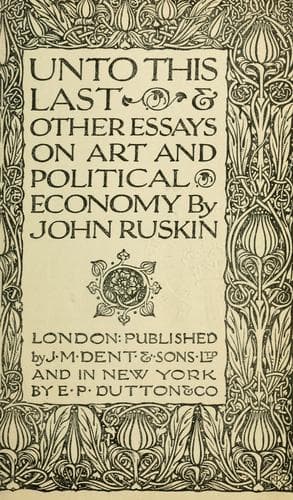
Unto This Last, and Other Essays on Political EconomyRuskin, John
General
Unto This Last, and Other Essays on Political Economy
Ruskin, John
Art; Economics
less to disguise it from himself. And it is matter of much doubt with
me, how far the foolish arguments used habitually on this subject are
indeed the honest expressions of foolish convictions,--or rather (as I
am sometimes forced to conclude from the irritation with which they
are advanced) are resolutely dishonest, wilful sophisms, arranged so
as to mask to the last moment the real state of economy, and future
duties of men. By taking a simple example, and working it thoroughly
out, the subject may be rescued from all but determined misconception.
[117] By his heart he may; but only when its produce, or the
sight or hearing of it, becomes a subject of dispute, so as
to enable the artist to tax the labour of multitudes highly,
in exchange for his own.
Let us imagine a society of peasants, living on a river-shore, exposed
to destructive inundation at somewhat extended intervals; and that
each peasant possesses of this good, but imperilled ground, more than
he needs to cultivate for immediate subsistence. We will assume
farther (and with too great probability of justice) that the greater
part of them indolently keep in tillage just as much land as supplies
them with daily food;--that they leave their children idle and
untaught; and take no precautions against the rise of the stream. But
one of them (we will say only one, for the sake of greater clearness)
cultivates carefully all the ground of his estate; makes his children
work hard and healthily; uses his spare time and theirs in building a
rampart against the river; and at the end of some years has in his
storehouses large reserves of food and clothing, and in his stables a
well-tended breed of cattle.
The torrent rises at last--sweeps away the harvests and many of the
cottages of the careless peasantry, and leaves them destitute. They
naturally come for help to the provident one, whose fields are
unwasted and whose granaries are full. He has the right to refuse it
them; no one disputes his right. But he will probably not refuse it;
it is not his interest to do so, even were he entirely selfish and
cruel. The only question with him will be on what terms his aid is to
be granted.
Public-domain text, read in full here on John Shaqi.
Reviews
Reviews
No reviews yet
Be the first to share your thoughts on this work.
Elsewhere in the archive
Join the Discussion
Join the discussion
Sign in to leave a comment or review.
Sign InorCreate an account