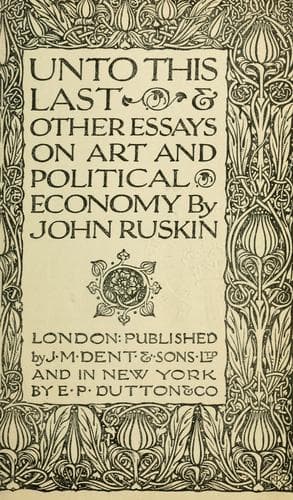
Unto This Last, and Other Essays on Political EconomyRuskin, John
General
Unto This Last, and Other Essays on Political Economy
Ruskin, John
Art; Economics
I passed this cottage often in my walks, had its window and door
mended, sometimes mended also a little the meal of sour bread and
broth, and generally got kind greeting and smile from the face of
young or old; which greeting, this year, narrowed itself into the
half-recognizing stare of the elder child and the old woman's tears;
for the father and mother were both dead,--one of sickness, the other
of sorrow. It happened that I passed not alone, but with a companion,
a practised English joiner, who, while these people were dying of
cold, had been employed from six in the morning to six of the evening
for two months, in fitting the panels without nails, of a single door
in a large house in London. Three days of his work taken, at the right
time, from the oak panels, and applied to the larch timbers, would
have saved these Savoyards' lives. He would have been maintained
equally (I suppose him equally paid for his work by the owner of the
greater house, only the work not consumed selfishly on his own walls;)
and the two peasants, and eventually, probably their children, saved.
There are, therefore, let me finally enforce and leave with the reader
this broad conclusion,--three things to be considered in employing any
poor person. It is not enough to give him employment. You must employ
him first to produce useful things; secondly, of the several (suppose
equally useful) things he can equally well produce, you must set him
to make that which will cause him to lead the healthiest life; lastly,
of the things produced, it remains a question of wisdom and conscience
how much you are to take yourself, and how much to leave to others. A
large quantity, remember, unless you destroy it, must always be so
left at one time or another; the only questions you have to decide
are, not what you will give, and what you will keep, but when, and
how, and to whom, you will give. The natural law of human life is, of
course, that in youth a man shall labour and lay by store for his old
age, and when age comes, should use what he has laid by, gradually
slackening his toil, and allowing himself more frank use of his store,
taking care always to leave himself as much as will surely suffice for
him beyond any possible length of life. What he has gained, or by
tranquil and unanxious toil, continues to gain, more than is enough
for his own need, he ought so to administer, while he yet lives, as to
see the good of it again beginning in other hands; for thus he has
himself the greatest sum of pleasure from it, and faithfully uses his
sagacity in its control. Whereas most men, it appears, dislike the
sight of their fortunes going out into service again, and say to
themselves,--"I can indeed nowise prevent this money from falling at
last into the hands of others, nor hinder the good of it, such as it
is, from becoming theirs, not mine; but at least let a merciful death
save me from being a witness of their satisfaction; and may God so far
Public-domain text, read in full here on John Shaqi.
Reviews
Reviews
No reviews yet
Be the first to share your thoughts on this work.
Elsewhere in the archive
Join the Discussion
Join the discussion
Sign in to leave a comment or review.
Sign InorCreate an account