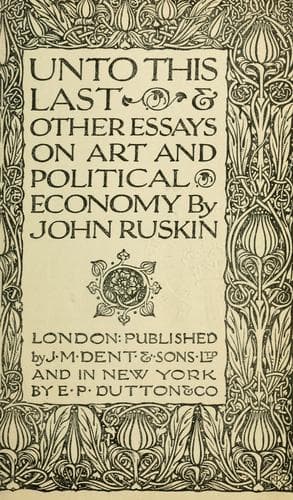
Unto This Last, and Other Essays on Political EconomyRuskin, John
General
Unto This Last, and Other Essays on Political Economy
Ruskin, John
Art; Economics
If you were to embank Lincolnshire now,--more stoutly against the sea?
or strip the peat of Solway, or plant Plinlimmon moors with
larch--then, in due hour of year, some amateur reaping and threshing?
"Nay, we reap and thresh by steam in these advanced days."
I know it, my wise and economical friends. The stout arms God gave
you to win your bread by, you would fain shoot your neighbours--and
God's sweet singers--with;[119] then you invoke the friends to your
farm-service, and--
"When young and old come forth to play
On a sulphurous holiday,
Tell how the darling goblin sweat
(His feast of cinders duly set),
And belching night, where breathed the morn.
His shadowy flail hath threshed the corn
That ten day-labourers could not end."
But we will press the example closer. On a green knoll above that
plain of the Arve, between Cluses and Bonneville, there was, in the
year 1860, a cottage, inhabited by a well-doing family--man and wife,
three children, and the grandmother. I call it a cottage but, in
truth, it was a large chimney on the ground, wide at the bottom (so
that the family might live round the fire), with one broken window in
it, and an unclosing door. The family, I say, was "well-doing," at
least, it was hopeful and cheerful; the wife healthy, the children,
for Savoyards, pretty and active, but the husband threatened with
decline, from exposure under the cliffs of the Mont Vergi by day, and
to draughts between every plank of his chimney in the frosty nights.
"Why could he not plaster the chinks?" asks the practical reader. For
the same reason that your child cannot wash its face and hands till
you have washed them many a day for it, and will not wash them when it
can, till you force it.
[119] Compare Chaucer's feeling respecting birds (from Canace's
falcon, to the nightingale, singing "Domine labia "--to the
Lord of Love) with the usual modern British sentiments on
this subject. Or even Cowley's:--
"What prince's choir of music can excel
That which within this shade does dwell.
To which we nothing pay, or give,
They, like all other poets, live
Without reward, or thanks for their obliging pains!
'Tis well if they became not prey."
Yes; it is better than well; particularly since the seed
sown by the wayside has been protected by the peculiar
appropriation of part of the church rates in our country
parishes. See the remonstrance from a "Country Parson," in
the _Times_ of June 4th (or 5th; the letter is dated June
3rd, 1862):--"I have heard at a vestry meeting a good deal
of higgling over a few shillings' outlay in cleaning the
church; but I have never heard any dissatisfaction expressed
on account of the part of the rate which is invested in
fifty or 100 dozens of birds' heads."
Public-domain text, read in full here on John Shaqi.
Reviews
Reviews
No reviews yet
Be the first to share your thoughts on this work.
Elsewhere in the archive
Join the Discussion
Join the discussion
Sign in to leave a comment or review.
Sign InorCreate an account