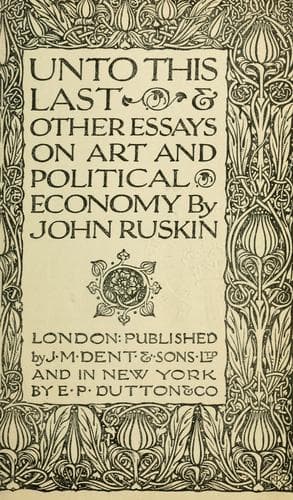
Unto This Last, and Other Essays on Political Economy — John Shaqi
Unto This Last, and Other Essays on Political EconomyRuskin, John
General
Unto This Last, and Other Essays on Political Economy
Ruskin, John
Art; Economics
Granted, that whenever we spend money for whatever purpose, we set
people to work; and, passing by, for the moment, the question whether
the work we set them to is all equally healthy and good for them, we
will assume that whenever we spend a guinea we provide an equal number
of people with healthy maintenance for a given time. But, by the way
in which we spend it, we entirely direct the labour of those people
during that given time. We become their masters or mistresses, and we
compel them to produce, within a certain period, a certain article.
Now, that article may be a useful and lasting one, or it may be a
useless and perishable one--it may be one useful to the whole
community, or useful only to ourselves. And our selfishness and folly,
or our virtue and prudence, are shown, not by our spending money, but
by our spending it for the wrong or the right thing; and we are wise
and kind, not in maintaining a certain number of people for a given
period, but only in requiring them to produce, during that period, the
kind of things which shall be useful to society, instead of those
which are only useful to ourselves.
Thus, for instance: if you are a young lady, and employ a certain
number of sempstresses for a given time, in making a given number of
simple and serviceable dresses, suppose, seven; of which you can wear
one yourself for half the winter, and give six away to poor girls who
have none, you are spending your money unselfishly. But if you employ
the same number of sempstresses for the same number of days, in
making four, or five, or six beautiful flounces for your own
ball-dress--flounces which will clothe no one but yourself, and which
you will yourself be unable to wear at more than one ball--you are
employing your money selfishly. You have maintained, indeed, in each
case, the same number of people; but in the one case you have directed
their labour to the service of the community; in the other case you
have consumed it wholly upon yourself. I don't say you are never to do
so; I don't say you ought not sometimes to think of yourselves only,
and to make yourselves as pretty as you can; only do not confuse
coquettishness with benevolence, nor cheat yourselves into thinking
that all the finery you can wear is so much put into the hungry mouths
of those beneath you: it is not so; it is what you yourselves, whether
you will or no, must sometimes instinctively feel it to be--it is what
those who stand shivering in the streets, forming a line to watch you
as you step out of your carriages, _know_ it to be; those fine dresses
do not mean that so much has been put into their mouths, but that so
much has been taken out of their mouths. The real politico-economical
signification of every one of those beautiful toilettes, is just this;
that you have had a certain number of people put for a certain
number of days wholly under your authority, by the sternest of
slave-masters--hunger and cold; and you have said to them, "I will
Public-domain text, read in full here on John Shaqi.
Reviews
Reviews
No reviews yet
Be the first to share your thoughts on this work.
Join the Discussion
Join the discussion
Sign in to leave a comment or review.
Sign InorCreate an account