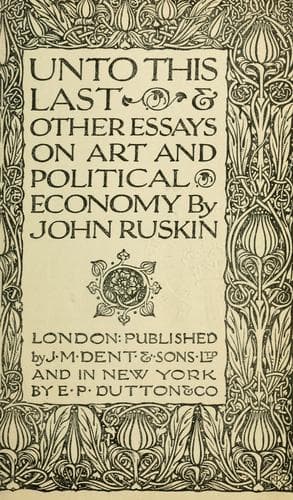
Unto This Last, and Other Essays on Political EconomyRuskin, John
General
Unto This Last, and Other Essays on Political Economy
Ruskin, John
Art; Economics
Now, you must have patience with me, if in approaching the specialty
of this subject, I dwell a little on certain points of general
political science already known or established: for though thus, as I
believe, established, some which I shall have occasion to rest
arguments on are not yet by any means universally accepted; and
therefore, though I will not lose time in any detailed defence of
them, it is necessary that I should distinctly tell you in what form I
receive, and wish to argue from them; and this the more, because there
may perhaps be a part of my audience who have not interested
themselves in political economy, as it bears on ordinary fields of
labour, but may yet wish to hear in what way its principles can be
applied to Art. I shall, therefore, take leave to trespass on your
patience with a few elementary statements in the outset, and with, the
expression of some general principles, here and there, in the course
of our particular inquiry.
To begin, then, with one of these necessary truisms: all economy,
whether of states, households, or individuals, may be defined to be
the art of managing labour. The world is so regulated by the laws of
Providence, that a man's labour, well applied, is always amply
sufficient to provide him during his life with all things needful to
him, and not only with those, but with many pleasant objects of
luxury; and yet farther, to procure him large intervals of healthful
rest and serviceable leisure. And a nation's labour, well applied, is
in like manner, amply sufficient to provide its whole population with
good food and comfortable habitation; and not with those only, but
with good education besides, and objects of luxury, art treasures,
such as these you have around you now. But by those same laws of
Nature and Providence, if the labour of the nation or of the
individual be misapplied, and much more if it be insufficient,--if the
nation or man be indolent and unwise,--suffering and want result,
exactly in proportion to the indolence and improvidence,--to the
refusal of labour, or to the misapplication of it. Wherever you see
want, or misery, or degradation, in this world about you, there, be
sure, either industry has been wanting, or industry has been in error.
It is not accident, it is not Heaven-commanded calamity, it is not the
original and inevitable evil of man's nature, which fill your streets
with lamentation, and your graves with prey. It is only that, when
there should have been providence, there has been waste; when there
should have been labour, there has been lasciviousness; and,
wilfulness, when there should have been subordination.[2]
[2] Proverbs xiii. 23: "Much food is in the tillage of the poor:
but there is that is destroyed for want of judgment."
Public-domain text, read in full here on John Shaqi.
Reviews
Reviews
No reviews yet
Be the first to share your thoughts on this work.
Join the Discussion
Join the discussion
Sign in to leave a comment or review.
Sign InorCreate an account