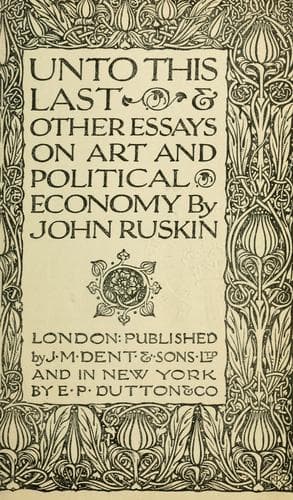
Unto This Last, and Other Essays on Political EconomyRuskin, John
General
Unto This Last, and Other Essays on Political Economy
Ruskin, John
Art; Economics
IV. DISTRIBUTION.--And now, lastly, we come to the fourth great head
of our inquiry, the question of the wise distribution of the art we
have gathered and preserved. It must be evident to us, at a moment's
thought, that the way in which works of art are on the whole most
useful to the nation to which they belong, must be by their collection
in public galleries, supposing those galleries properly managed. But
there is one disadvantage attached necessarily to gallery exhibition,
namely, the extent of mischief which may be done by one foolish
curator. As long as the pictures which form the national wealth are
disposed in private collections, the chance is always that the people
who buy them will be just the people who are fond of them; and that
the sense of exchangeable value in the commodity they possess, will
induce them, even if they do not esteem it themselves, to take such
care of it as will preserve its value undiminished. At all events, so
long as works of art are scattered through the nation, no universal
destruction of them is possible; a certain average only are lost by
accidents from time to time. But when they are once collected in a
large public gallery, if the appointment of curator becomes in any way
a matter of formality, or the post is so lucrative as to be disputed
by place-hunters, let but one foolish or careless person get
possession of it, and perhaps you may have all your fine pictures
repainted, and the national property destroyed, in a month. That is
actually the case at this moment, in several great foreign galleries.
They are the places of execution of pictures: over their doors you
only want the Dantesque inscription, "Lasciate ogni speranza, voi che
entrate."
Supposing, however, this danger properly guarded against, as it would
be always by a nation which either knew the value, or understood the
meaning, of painting,[13] arrangement in a public gallery is the
safest, as well as the most serviceable, method of exhibiting
pictures; and it is the only mode in which their historical value can
be brought out, and their historical meaning made clear. But great
good is also to be done by encouraging the private possession of
pictures; partly as a means of study (much more being always
discovered in any work of art by a person who has it perpetually near
him than by one who only sees it from time to time), and also as a
means of refining the habits and touching the hearts of the masses of
the nation in their domestic life.
[13] It would be a great point gained towards the preservation
of pictures if it were made a rule that at every operation
they underwent, the exact spots in which they have been
re-painted should be recorded in writing.
Public-domain text, read in full here on John Shaqi.
Reviews
Reviews
No reviews yet
Be the first to share your thoughts on this work.
Elsewhere in the archive
Join the Discussion
Join the discussion
Sign in to leave a comment or review.
Sign InorCreate an account