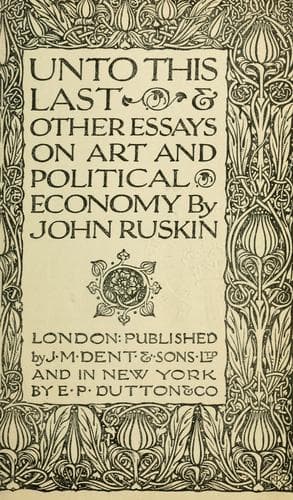
Unto This Last, and Other Essays on Political EconomyRuskin, John
General
Unto This Last, and Other Essays on Political Economy
Ruskin, John
Art; Economics
to imagine that the possession of pictures by a given artist adds to
their "gentility," and there is no price which his work may not
immediately reach, and for years maintain; and in buying at that
price, you are not getting value for your money, but merely disputing
for victory in a contest of ostentation. And it is hardly possible to
spend your money in a worse or more wasteful way; for though you may
not be doing it for ostentation yourself, you are, by your
pertinacity, nourishing the ostentation of others; you meet them in
their game of wealth, and continue it for them; if they had not found
an opposite player, the game would have been done; for a proud man can
find no enjoyment in possessing himself of what nobody disputes with
him. So that by every farthing you give for a picture beyond its fair
price--that is to say, the price which will pay the painter for his
time--you are not only cheating yourself and buying vanity, but you
are stimulating the vanity of others; paying literally, for the
cultivation of pride. You may consider every pound that you spend
above the just price of a work of art, as an investment in a cargo of
mental quick-lime or guano, which, being laid on the fields of human
nature, is to grow a harvest of pride. You are in fact ploughing and
harrowing, in a most valuable part of your land, in order to reap the
whirlwind; you are setting your hand stoutly to Job's agriculture,
"Let thistles grow instead of wheat, and cockle instead of barley."
Well, but you will say, there is one advantage in high prices, which
more than counterbalances all this mischief, namely, that by great
reward we both urge and enable a painter to produce rather one perfect
picture than many inferior ones: and one perfect picture (so you tell
us, and we believe it) is worth a great number of inferior ones.
It is so; but you cannot get it by paying for it. A great work is only
done when the painter gets into the humour for it, likes his subject,
and determines to paint it as well as he can, whether he is paid for
it or not; but bad work, and generally the worst sort of bad work, is
done when he is trying to produce a showy picture, or one that shall
appear to have as much labour in it as shall be worth a high
price.[14]
Public-domain text, read in full here on John Shaqi.
Reviews
Reviews
No reviews yet
Be the first to share your thoughts on this work.
Elsewhere in the archive
Join the Discussion
Join the discussion
Sign in to leave a comment or review.
Sign InorCreate an account