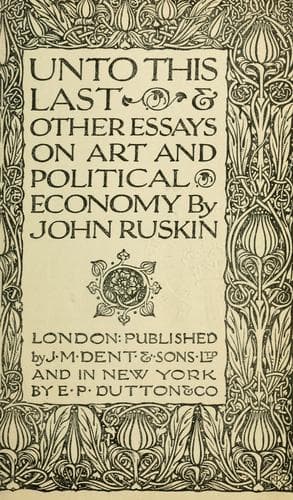
Unto This Last, and Other Essays on Political EconomyRuskin, John
General
Unto This Last, and Other Essays on Political Economy
Ruskin, John
Art; Economics
This statement could not, of course, be heard without displeasure by a
certain class of politicians; and in one of the notices of these
lectures given in the Manchester journals at the time, endeavour was
made to get quit of it by referring to the Divine authority, as the
only Paternal power with respect to which men were truly styled
"brethren." Of course it is so, and, equally of course, all human
government is nothing else than the executive expression of this
Divine authority. The moment government ceases to be the practical
enforcement of Divine law, it is tyranny; and the meaning which I
attach to the words, "paternal government," is, in more extended
terms, simply this--"The executive fulfilment, by formal human
methods, of the will of the Father of mankind respecting His
children." I could not give such a definition of Government as this in
a popular lecture; and even in written form, it will necessarily
suggest many objections, of which I must notice and answer the most
probable.
Only, in order to avoid the recurrence of such tiresome phrases as "it
may be answered in the second place," and "it will be objected in the
third place," etc., I will ask the reader's leave to arrange the
discussion in the form of simple dialogue, letting _O._ stand for
objector, and _R._ for response.
_O._--You define your paternal government to be the executive
fulfilment, by formal human methods, of the Divine will. But,
assuredly, that will cannot stand in need of aid or expression from
human laws. It cannot fail of its fulfilment.
_R._--In the final sense it cannot; and in that sense, men who are
committing murder and stealing are fulfilling the will of God as much
as the best and kindest people in the world. But in the limited and
present sense, the only sense with which _we_ have anything to do,
God's will concerning man is fulfilled by some men, and thwarted by
others. And those men who either persuade or enforce the doing of it,
stand towards those who are rebellious against it exactly in the
position of faithful children in a family, who, when the father is out
of sight, either compel or persuade the rest to do as their father
would have them, were he present; and in so far as they are expressing
and maintaining, for the time, the paternal authority, they exercise,
in the exact sense in which I mean the phrase to be understood,
paternal government over the rest.
_O._--But, if Providence has left a liberty to man in many things in
order to prove him, why should human law abridge that liberty, and
take upon itself to compel what the great Lawgiver does not compel?
Public-domain text, read in full here on John Shaqi.
Reviews
Reviews
No reviews yet
Be the first to share your thoughts on this work.
Elsewhere in the archive
Join the Discussion
Join the discussion
Sign in to leave a comment or review.
Sign InorCreate an account