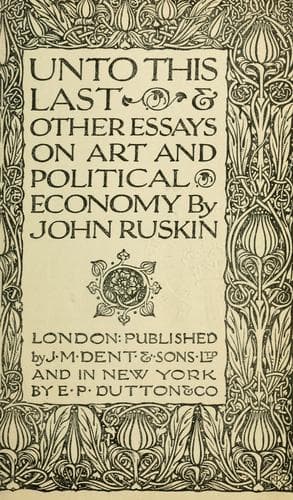
Unto This Last, and Other Essays on Political EconomyRuskin, John
General
Unto This Last, and Other Essays on Political Economy
Ruskin, John
Art; Economics
_R._--It is confessed, in the enactment of any law whatsoever, that
human lawgivers have a right to do this. For, if you have no right to
abridge any of the liberty which Providence has left to man, you have
no right to punish any one for committing murder or robbery. You ought
to leave them to the punishment of God and Nature. But if you think
yourself under obligation to punish, as far as human laws can, the
violation of the will of God by those great sins, you are certainly
under the same obligation to punish, with proportionately less
punishment, the violation of His will in less sins.
_O._--No; you must not attempt to punish less sins by law, because you
cannot properly define nor ascertain them. Everybody can determine
whether murder has been committed or not, but you cannot determine how
far people have been unjust or cruel in minor matters, and therefore
cannot make or execute laws concerning minor matters.
_R._--If I propose to you to punish faults which cannot be defined, or
to execute laws which cannot be made equitable, reject the laws I
propose. But do not generally object to the principle of law.
_O._--Yes; I generally object to the principle of law as applied to
minor things; because, if you could succeed (which you cannot) in
regulating the entire conduct of men by law in little things as well
as great, you would take away from human life all its probationary
character, and render many virtues and pleasures impossible. You would
reduce virtue to the movement of a machine, instead of the act of a
spirit.
_R._--You have just said, parenthetically, and I fully and willingly
admit it, that it is impossible to regulate all minor matters by law.
Is it not probable, therefore, that the degree in which it is
_possible_ to regulate them by it, is also the degree in which it is
_right_ to regulate them by it? Or what other means of judgment will
you employ, to separate the things which ought to be formally
regulated from the things which ought not. You admit that great sins
should be legally repressed; but you say that small sins should not be
legally repressed. How do you distinguish between great and small
sins; and how do you intend to determine, or do you in practice of
daily life determine, on what occasions you should compel people to do
right, and on what occasions you should leave them the option of doing
wrong?
_O._--I think you cannot make any accurate or logical distinction in
such matters; but that common sense and instinct have, in all
civilized nations, indicated certain crimes of great social
harmfulness, such as murder, theft, adultery, slander, and such like,
which it is proper to repress legally; and that common sense and
instinct indicate also the kind of crimes which it is proper for laws
to let alone, such as miserliness, ill-natured speaking, and many of
those commercial dishonesties which I have a notion you want your
paternal government to interfere with.
Public-domain text, read in full here on John Shaqi.
Reviews
Reviews
No reviews yet
Be the first to share your thoughts on this work.
Elsewhere in the archive
Join the Discussion
Join the discussion
Sign in to leave a comment or review.
Sign InorCreate an account