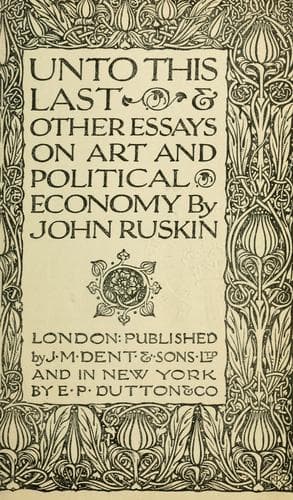
Unto This Last, and Other Essays on Political EconomyRuskin, John
General
Unto This Last, and Other Essays on Political Economy
Ruskin, John
Art; Economics
and coals, because everybody would understand what those meant. Mind,
I do not want any one to refuse the carriage who ought to have it; but
neither do I want them to refuse the coals. I should indeed be sorry
if any change in our views on these subjects involved the least
lessening of self-dependence in the English mind: but the common
shrinking of men from the acceptance of public charity is not
self-dependence, but mere base and selfish pride. It is not that they
are unwilling to live at their neighbours' expense, but that they are
unwilling to confess they do: it is not dependence they wish to avoid,
but gratitude. They will take places in which they know there is
nothing to be done--they will borrow money they know they cannot
repay--they will carry on a losing business with other people's
capital--they will cheat the public in their shops, or sponge on their
friends at their houses; but to say plainly they are poor men, who
need the nation's help, and go into an almshouse--this they loftily
repudiate, and virtuously prefer being thieves to being paupers.
I trust that these deceptive efforts of dishonest men to appear
independent, and the agonizing efforts of unfortunate men to remain
independent, may both be in some degree checked by a better
administration and understanding of laws respecting the poor. But the
ordinances for relief and the ordinances for labour must go together;
otherwise distress caused by misfortune will always be confounded, as
it is now, with distress caused by idleness, unthrift, and fraud. It
is only when the state watches and guides the middle life of men, that
it can, without disgrace to them, protect their old age, acknowledging
in that protection that they have done their duty, or at least some
portion of their duty, in better days.
I know well how strange, fanciful, or impracticable these suggestions
will appear to most of the business men of this day; men who conceive
the proper state of the world to be simply that of a vast and
disorganized mob, scrambling each for what he can get, trampling down
its children and old men in the mire, and doing what work it finds
_must_ be done with any irregular squad of labourers it can bribe or
inveigle together, and afterwards scatter to starvation. A great deal
may, indeed, be done in this way by a nation strong-elbowed and
strong-hearted as we are--not easily frightened by pushing, nor
discouraged by falls. But it is still not the right way of doing
things for people who call themselves Christians. Every so named soul
of man claims from every other such soul, protection and education in
childhood--help or punishment in middle life--reward or relief, if
needed, in old age; all of these should be completely and unstintingly
given; and they can only be given by the organization of such a system
as I have described.
Note 3rd, p. 24.--"_Trial Schools._"
Public-domain text, read in full here on John Shaqi.
Reviews
Reviews
No reviews yet
Be the first to share your thoughts on this work.
Elsewhere in the archive
Join the Discussion
Join the discussion
Sign in to leave a comment or review.
Sign InorCreate an account