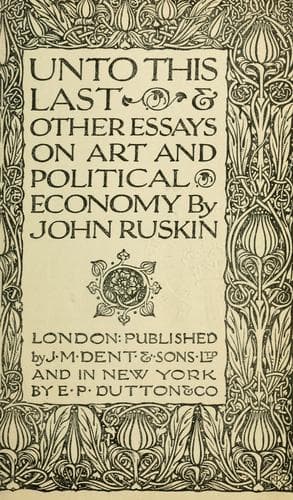
Unto This Last, and Other Essays on Political EconomyRuskin, John
General
Unto This Last, and Other Essays on Political Economy
Ruskin, John
Art; Economics
It may be seriously questioned by the reader how much of painting
talent we really lose on our present system,[20] and how much we
should gain by the proposed trial schools. For it might be thought,
that as matters stand at present, we have more painters than we ought
to have, having so many bad ones, and that all youths who had true
painters' genius forced their way out of obscurity.
[20] It will be observed that, in the lecture, it is _assumed_
that works of art are national treasures; and that it is
desirable to withdraw all the hands capable of painting or
carving from other employments, in order that they may
produce this kind of wealth. I do not, in assuming this,
mean that works of art add to the monetary resources of a
nation, or form part of its wealth, in the vulgar sense. The
result of the sale of a picture in the country itself is
merely that a certain sum of money is transferred from the
hands of B. the purchaser, to those of A. the producer; the
sum ultimately to be distributed remaining the same, only A.
ultimately spending it instead of B., while the labour of A.
has been in the meantime withdrawn from productive channels;
he has painted a picture which nobody can live upon, or live
in, when he might have grown corn or built houses; when the
sale therefore is effected in the country itself, it does
not add to, but diminishes, the monetary resources of the
country, except only so far as it may appear probable, on
other grounds, that A. is likely to spend the sum he
receives for his picture more rationally and usefully than
B. would have spent it. If, indeed, the picture, or other
work of art, be sold in foreign countries, either the money
or the useful products of the foreign country being imported
in exchange for it, such sale adds to the monetary resources
of the selling, and diminishes those of the purchasing
nation. But sound political economy, strange as it may at
first appear to say so, has nothing whatever to do with
separations between national interests. Political economy
means the management of the affairs of _citizens_; and it
either regards exclusively the administration of the affairs
of one nation, or the administration of the affairs of the
world considered as one nation. So when a transaction
between individuals which enriches A., impoverishes B. in
precisely the same degree, the sound economist considers it
an unproductive transaction between the individuals; and if
a trade between two nations which enriches one, impoverishes
the other in the same degree, the sound eoonomist considers
it an unproductive trade between the nations. It is not a
general question of political economy, but only a particular
Public-domain text, read in full here on John Shaqi.
Reviews
Reviews
No reviews yet
Be the first to share your thoughts on this work.
Elsewhere in the archive
Join the Discussion
Join the discussion
Sign in to leave a comment or review.
Sign InorCreate an account