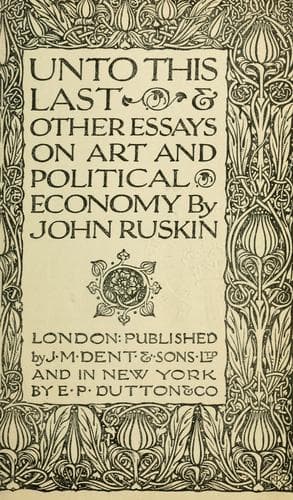
Unto This Last, and Other Essays on Political EconomyRuskin, John
General
Unto This Last, and Other Essays on Political Economy
Ruskin, John
Art; Economics
This is not so. It is difficult to analyse the characters of mind
which cause youths to mistake their vocation, and to endeavour to
become artists, when they have no true artist's gift. But the fact is,
that multitudes of young men do this, and that by far the greater
number of living artists are men who have mistaken their vocation. The
peculiar circumstances of modern life, which exhibit art in almost
every form to the sight of the youths in our great cities, have a
natural tendency to fill their imaginations with borrowed ideas, and
their minds with imperfect science; the mere dislike of mechanical
employments, either felt to be irksome, or believed to be degrading,
urges numbers of young men to become painters, in the same temper in
which they would enlist or go to sea; others, the sons of engravers or
artists, taught the business of the art by their parents, and having
no gift for it themselves, follow it as the means of livelihood, in an
ignoble patience; or, if ambitious, seek to attract regard, or
distance rivalry, by fantastic, meretricious, or unprecedented
applications of their mechanical skill; while finally, many men
earnest in feeling, and conscientious in principle, mistake their
desire to be useful for a love of art, and their quickness of emotion
for its capacity, and pass their lives in painting moral and
instructive pictures, which might almost justify us in thinking nobody
could be a painter but a rogue. On the other hand, I believe that much
of the best artistical intellect is daily lost in other avocations.
Generally, the temper which would make an admirable artist is humble
and observant, capable of taking much interest in little things, and
of entertaining itself pleasantly in the dullest circumstances.
Suppose, added to these characters, a steady conscientiousness which
seeks to do its duty wherever it may be placed, and the power, denied
to few artistical minds, of ingenious invention in almost any
practical department of human skill, and it can hardly be doubted that
the very humility and conscientiousness which would have perfected the
painter, have in many instances prevented his becoming one; and that
in the quiet life of our steady craftsmen--sagacious manufacturers and
uncomplaining clerks--there may frequently be concealed more genius
than ever is raised to the direction of our public works, or to be the
mark of our public praises.
Public-domain text, read in full here on John Shaqi.
Reviews
Reviews
No reviews yet
Be the first to share your thoughts on this work.
Elsewhere in the archive
Join the Discussion
Join the discussion
Sign in to leave a comment or review.
Sign InorCreate an account