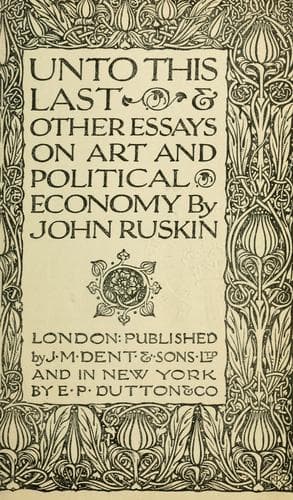
Unto This Last, and Other Essays on Political EconomyRuskin, John
General
Unto This Last, and Other Essays on Political Economy
Ruskin, John
Art; Economics
question of local expediency, whether an article in itself
valueless, may bear a value of exchange in transactions with
some other nation. The economist considers only the actual
value of the thing done or produced; and if he sees a
quantity of labour spent, for instance, by the Swiss, in
producing woodwork for sale to the English, he at once sets
the commercial impoverishment of the English purchaser
against the commercial enrichment of the Swiss seller; and
considers the whole transaction productive only so far as
the woodwork itself is a real addition to the wealth of the
world. For the arrangement of the laws of a nation so as to
procure the greatest advantages to itself, and leave the
smallest advantages to other nations, is not a part of the
science of political economy, but merely a broad application
of the science of fraud. Considered thus in the abstract,
pictures are not an _addition_ to the monetary wealth of the
world, except in the amount of pleasure or instruction to be
got out of them day by day: but there is a certain
protective effect on wealth exercised by works of high art
which must always be included in the estimate of their
value. Generally speaking, persons who decorate their houses
with pictures, will not spend so much money in papers,
carpets, curtains, or other expensive and perishable
luxuries as they would otherwise. Works of good art, like
books, exercise a conservative effect on the rooms they are
kept in; and the wall of the library or picture gallery
remains undisturbed, when those of other rooms are
re-papered or re-panelled. Of course, this effect is still
more definite when the picture is on the walls themselves,
either on canvass stretched into fixed shapes on their
panels, or in fresco; involving, of course, the preservation
of the building from all unnecessary and capricious
alteration. And generally speaking, the occupation of a
large number of hands in painting or sculpture in any nation
may be considered as tending to check the disposition to
indulge in perishable luxury. I do not, however, in my
assumption that works of art are treasures, take much into
consideration this collateral monetary result. I consider
them treasures, merely as permanent means of pleasure and
instruction; and having at other times tried to show the
several ways in which they can please and teach, assume here
that they are thus useful; and that it is desirable to make
as many painters as we can.
Public-domain text, read in full here on John Shaqi.
Reviews
Reviews
No reviews yet
Be the first to share your thoughts on this work.
Elsewhere in the archive
Join the Discussion
Join the discussion
Sign in to leave a comment or review.
Sign InorCreate an account