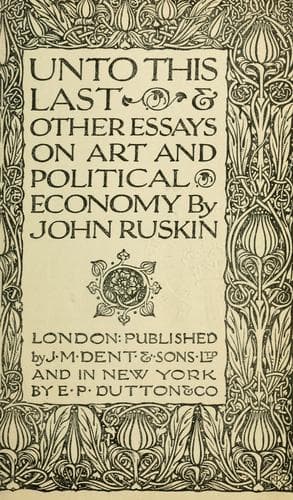
Unto This Last, and Other Essays on Political EconomyRuskin, John
General
Unto This Last, and Other Essays on Political Economy
Ruskin, John
Art; Economics
There is great difficulty in making any short or general statement of
the difference between great and ignoble minds in their behaviour to
the "public." It is by no means _universally_ the case that a mean
mind, as stated in the text, will bend itself to what you ask of it:
on the contrary, there is one kind of mind, the meanest of all, which
perpetually complains of the public, contemplates and proclaims itself
as a "genius," refuses all wholesome discipline or humble office, and
ends in miserable and revengeful ruin; also, the greatest minds are
marked by nothing more distinctly than an inconceivable humility, and
acceptance of work or instruction in any form, and from any quarter.
They will learn from everybody, and do anything that anybody asks of
them, so long as it involves only toil, or what other men would think
degradation. But the point of quarrel, nevertheless, assuredly rises
some day between the public and them, respecting some matter, not of
humiliation, but of Fact. Your great man always at last comes to see
something the public don't see. This something he will assuredly
persist in asserting, whether with tongue or pencil, to be as _he_
sees it, not as _they_ see it; and all the world in a heap on the
other side will not get him to say otherwise. Then, if the world
objects to the saying, he may happen to get stoned or burnt for it,
but that does not in the least matter to him; if the world has no
particular objection to the saying, he may get leave to mutter it to
himself till he dies, and be merely taken for an idiot; that also
does not matter to him--mutter it he will, according to what he
perceives to be fact, and not at all according to the roaring of the
walls of Red sea on the right hand or left of him. Hence the quarrel,
sure at some time or other to be started between the public and him;
while your mean man, though he will spit and scratch spiritedly at the
public, while it does not attend to him, will bow to it for its clap
in any direction, and say anything when he has got its ear, which he
thinks will bring him another clap; and thus, as stated in the text,
he and it go on smoothly together.
There are, however, times when the obstinacy of the mean man looks
very like the obstinacy of the great one; but if you look closely into
the matter, you will always see that the obstinacy of the first is in
the pronunciation of "I;" and of the second, in the pronunciation of
"It."
Note 5th, p. 38.--"_Invention of new wants._"
Public-domain text, read in full here on John Shaqi.
Reviews
Reviews
No reviews yet
Be the first to share your thoughts on this work.
Elsewhere in the archive
Join the Discussion
Join the discussion
Sign in to leave a comment or review.
Sign InorCreate an account