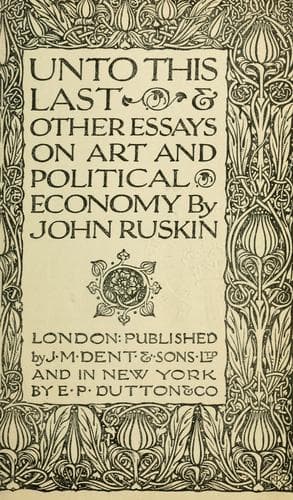
Unto This Last, and Other Essays on Political EconomyRuskin, John
General
Unto This Last, and Other Essays on Political Economy
Ruskin, John
Art; Economics
It would have been impossible for political economists long to have
endured the error spoken of in the text,[21] had they not been
confused by an idea, in part well founded, that the energies and
refinements, as well as the riches of civilized life arose from
imaginary wants. It is quite true, that the savage who knows no needs
but those of food, shelter, and sleep, and after he has snared his
venison and patched the rents of his hut, passes the rest of his time
in animal repose, is in a lower state than the man who labours
incessantly that he may procure for himself the luxuries of
civilization; and true also, that the difference between one and
another nation in progressive power depends in great part on vain
desires; but these idle motives are merely to be considered as giving
exercise to the national body and mind; they are not sources of
wealth, except so far as they give the habits of industry and
acquisitiveness. If a boy is clumsy and lazy, we shall do good if we
can persuade him to carve cherrystones and fly kites; and this use of
his fingers and limbs may eventually be the cause of his becoming a
wealthy and happy man; but we must not therefore argue that
cherrystones are valuable property, or that kite-flying is a
profitable mode of passing time. In like manner, a nation always
wastes its time and labour _directly_, when it invents a new want of a
frivolous kind, and yet the invention of such a want may be the sign
of a healthy activity, and the labour undergone to satisfy the new
want may lead, _indirectly_, to useful discoveries or to noble arts;
so that a nation is not to be discouraged in its fancies when it is
either too weak or foolish to be moved to exertion by anything but
fancies, or has attended to its serious business first. If a nation
will not forge iron, but likes distilling lavender, by all means give
it lavender to distil; only do not let its economists suppose that
lavender is as profitable to it as oats, or that it helps poor people
to live, any more than the schoolboy's kite provides him his dinner.
Luxuries, whether national or personal, must be paid for by labour
withdrawn from useful things; and no nation has a right to indulge in
them until all its poor are comfortably housed and fed.
Public-domain text, read in full here on John Shaqi.
Reviews
Reviews
No reviews yet
Be the first to share your thoughts on this work.
Elsewhere in the archive
Join the Discussion
Join the discussion
Sign in to leave a comment or review.
Sign InorCreate an account