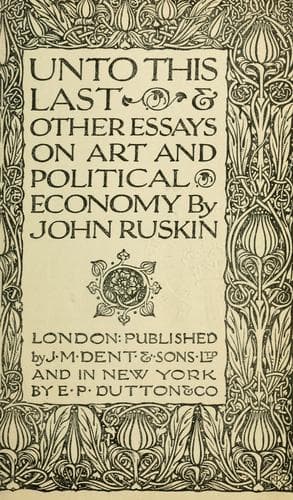
Unto This Last, and Other Essays on Political EconomyRuskin, John
General
Unto This Last, and Other Essays on Political Economy
Ruskin, John
Art; Economics
Some distinction is made by us naturally in this respect between
earned and inherited wealth; that which is inherited appearing to
involve the most definite responsibilities, especially when consisting
in revenues derived from the soil. The form of taxation which
constitutes rental of lands places annually a certain portion of the
national wealth in the hands of the nobles, or other proprietors of
the soil, under conditions peculiarly calculated to induce them to
give their best care to its efficient administration. The want of
instruction in even the simplest principles of commerce and economy,
which hitherto has disgraced our schools and universities, has indeed
been the cause of ruin or total inutility of life to multitudes of our
men of estate; but this deficiency in our public education cannot
exist much longer, and it appears to be highly advantageous for the
State that a certain number of persons distinguished by race should be
permitted to set examples of wise expenditure, whether in the
advancement of science, or in patronage of art and literature; only
they must see to it that they take their right standing more firmly
than they have done hitherto, for the position of a rich man in
relation to those around him is, in our present real life, and is also
contemplated generally by political economists as being, precisely the
reverse of what it ought to be. A rich man ought to be continually
examining how he may spend his money for the advantage of others: at
present, others are continually plotting how they may beguile him into
spending it apparently for his own. The aspect which he presents to
the eyes of the world is generally that of a person holding a bag of
money with a staunch grasp, and resolved to part with none of it
unless he is forced, and all the people about him are plotting how
they may force him; that is to say, how they may persuade him that he
wants this thing or that; or how they may produce things that he will
covet and buy. One man tries to persuade him that he wants perfumes;
another that he wants jewellery; another that he wants sugarplums;
another that he wants roses at Christmas. Anybody who can invent a new
want for him is supposed to be a benefactor to society: and thus the
energies of the poorer people about him are continually directed to
the production of covetable, instead of serviceable things; and the
rich man has the general aspect of a fool, plotted against by all the
world. Whereas the real aspect which he ought to have is that of a
person wiser than others, entrusted with the management of a larger
quantity of capital, which he administers for the profit of all,
directing each man to the labour which is most healthy for him, and
most serviceable for the community.
Note 8th, p. 84.--"_Silk and Purple._"
Public-domain text, read in full here on John Shaqi.
Reviews
Reviews
No reviews yet
Be the first to share your thoughts on this work.
Elsewhere in the archive
Join the Discussion
Join the discussion
Sign in to leave a comment or review.
Sign InorCreate an account