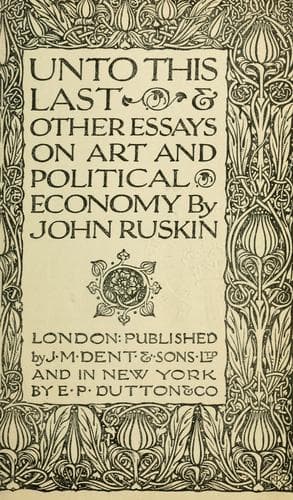
Unto This Last, and Other Essays on Political EconomyRuskin, John
General
Unto This Last, and Other Essays on Political Economy
Ruskin, John
Art; Economics
[22] There can be no question, however, of the mischievous
tendency of the hurry of the present day, in the way people
undertake this very _looking_. I gave three years' close and
incessant labour to the examination of the chronology of the
architecture of Venice; two long winters being wholly spent
in the drawing of details on the spot: and yet I see
constantly that architects who pass three or four days in a
gondola going up and down the Grand Canal, think that their
first impressions are just as likely to be true as my
patiently wrought conclusions. Mr. Street, for instance,
glances hastily at the facade of the Ducal Palace--so hastily
that he does not even see what its pattern is, and misses the
alternation of red and black in the centres of its
squares--and yet he instantly ventures on an opinion on the
chronology of its capitals, which is one of the most
complicated and difficult subjects in the whole range of
Gothic archaeology. It may, nevertheless, be ascertained with
very fair probability of correctness by any person who will
give a month's hard work to it, but it can be ascertained no
otherwise.
Note 7th, p. 84.--"_Pilots of the State._"
While, however, undoubtedly, these responsibilities attach to every
person possessed of wealth, it is necessary both to avoid any
stringency of statement respecting the benevolent modes of spending
money, and to admit and approve so much liberty of spending it for
selfish pleasures as may distinctly make wealth a personal _reward_
for toil, and secure in the minds of all men the right of property.
For although, without doubt, the purest pleasures it can procure are
not selfish, it is only as a means of personal gratification that it
will be desired by a large majority of workers; and it would be no
less false ethics than false policy to check their energy by any forms
of public opinion which bore hardly against the wanton expenditure of
honestly got wealth. It would be hard if a man who had passed the
greater part of his life at the desk or counter could not at last
innocently gratify a caprice; and all the best and most sacred ends of
almsgiving would be at once disappointed, if the idea of a moral claim
took the place of affectionate gratitude in the mind of the receiver.
Public-domain text, read in full here on John Shaqi.
Reviews
Reviews
No reviews yet
Be the first to share your thoughts on this work.
Elsewhere in the archive
Join the Discussion
Join the discussion
Sign in to leave a comment or review.
Sign InorCreate an account