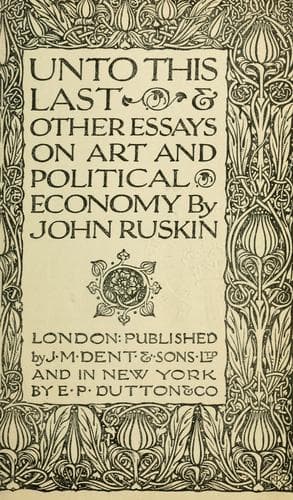
Unto This Last, and Other Essays on Political EconomyRuskin, John
General
Unto This Last, and Other Essays on Political Economy
Ruskin, John
Art; Economics
2. Property necessary to life, but only producible by labour, and of
which the possession is morally connected with labour, so that no
person capable of doing the work necessary for its production has a
right to it until he has done that work:--"he that will not work,
neither should he eat." It consists of simple food, clothing, and
habitation, with their seeds and materials, or instruments and
machinery, and animals used for necessary draught or locomotion, etc.
It is to be observed of this kind of property, that its increase
cannot usually be carried beyond a certain point, because it depends
not on labour only, but on things of which the supply is limited by
nature. The possible accumulation of corn depends on the quantity of
corn-growing land possessed or commercially accessible; and that of
steel, similarly, on the accessible quantity of coal and ironstone. It
follows from this natural limitation of supply that the accumulation
of property of this kind in large masses at one point, or in one
person's hands, commonly involves, more or less, the scarcity of it at
another point and in other persons' hands; so that the accidents or
energies which may enable one man to procure a great deal of it, may,
and in all likelihood will partially prevent other men procuring a
sufficiency of it, however willing they may be to work for it;
therefore, the modes of its accumulation and distribution need to be
in some degree regulated by law and by national treaties, in order to
secure justice to all men.
Another point requiring notice respecting this sort of property is,
that no work can be wasted in producing it, provided only the kind of
it produced be preservable and distributable, since for every grain of
such commodities we produce we are rendering so much more life
possible on earth.[23] But though we are sure, thus, that we are
employing people well, we cannot be sure we might not have employed
them _better_; for it is possible to direct labour to the production
of life, until little or none is left for that of the objects of life,
and thus to increase population at the expense of civilization,
learning, and morality: on the other hand, it is just as possible--and
the error is one to which the world is, on the whole, more liable--to
direct labour to the objects of life till too little is left for life,
and thus to increase luxury or learning at the expense of population.
Right political economy holds its aim poised justly between the two
extremes, desiring neither to crowd its dominions with a race of
savages, nor to found courts and colleges in the midst of a desert.
Public-domain text, read in full here on John Shaqi.
Reviews
Reviews
No reviews yet
Be the first to share your thoughts on this work.
Elsewhere in the archive
Join the Discussion
Join the discussion
Sign in to leave a comment or review.
Sign InorCreate an account