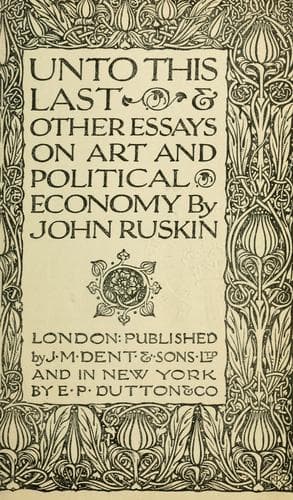
Unto This Last, and Other Essays on Political EconomyRuskin, John
General
Unto This Last, and Other Essays on Political Economy
Ruskin, John
Art; Economics
[23] This point has sometimes been disputed; for instance,
opening Mill's "Political Economy" the other day, I chanced
on a passage in which he says that a man who makes a coat,
if the person who wears the coat does nothing useful while
he wears it, has done no more good to society than the man
who has only raised a pineapple. But this is a fallacy
induced by endeavour after too much subtlety. None of us
have a right to say that the life of a man is of no use to
_him_, though it may be of no use to _us_; and the man who
made the coat, and thereby prolonged another man's life, has
done a gracious and useful work, whatever may come of the
life so prolonged. We may say to the wearer of the coat,
"You who are wearing coats, and doing nothing in them, are
at present wasting your own life and other people's;" but we
have no right to say that his existence, however wasted, is
wasted _away_. It may be just dragging itself on, in its
thin golden line, with nothing dependent upon it, to the
point where it is to strengthen into good chain cable, and
have thousands of other lives dependent on it. Meantime, the
simple fact respecting the coat-maker is, that he has given
so much life to the creature, the results of which he cannot
calculate; they may be--in all probability will be--infinite
results in some way. But the raiser of pines, who has only
given a pleasant taste in the mouth to some one, may see
with tolerable clearness to the end of the taste in the
mouth, and of all conceivable results therefrom.
3. The third kind of property is that which conduces to bodily
pleasures and conveniences, without directly tending to sustain life;
perhaps sometimes indirectly tending to destroy it. All dainty (as
distinguished from nourishing) food, and means of producing it; all
scents not needed for health; substances valued only for their
appearance and rarity (as gold and jewels); flowers of difficult
culture; animals used for delight (as horses for racing), and such
like, form property of this class; to which the term "luxury, or
luxuries," ought exclusively to belong.
Respecting which we have to note first, that all such property is of
doubtful advantage even to its possessor. Furniture tempting to
indolence, sweet odours, and luscious food, are more or less injurious
to health: while jewels, liveries, and other such common belongings of
wealthy people, certainly convey no pleasure to their owners
proportionate to their cost.
Public-domain text, read in full here on John Shaqi.
Reviews
Reviews
No reviews yet
Be the first to share your thoughts on this work.
Elsewhere in the archive
Join the Discussion
Join the discussion
Sign in to leave a comment or review.
Sign InorCreate an account