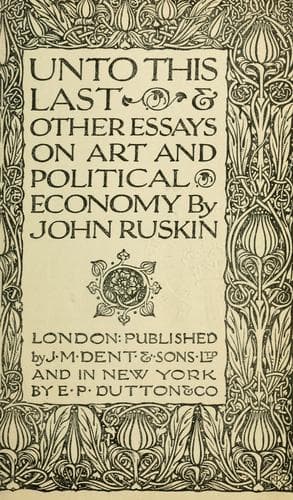
Unto This Last, and Other Essays on Political EconomyRuskin, John
General
Unto This Last, and Other Essays on Political Economy
Ruskin, John
Art; Economics
of art; and who have none;" and the former class will include all
noble persons, except only a few who make the world their garden or
museum; while the people who have not, or, which is the same thing, do
not care for gardens or libraries, but care for nothing but money or
luxuries, will include none but ignoble persons: only it is necessary
to understand that I mean by the term "garden" as much the
Carthusian's plot of ground fifteen feet square between his monastery
buttresses, as I do the grounds of Chatsworth or Kew; and I mean by
the term "art" as much the old sailor's print of the Arethusa bearing
up to engage the Belle Poule, as I do Raphael's "Disputa," and even
rather more; for when abundant, beautiful possessions of this kind are
almost always associated with vulgar luxury, and become then anything
but indicative of noble character in their possessors. The ideal of
human life is a union of Spartan simplicity of manners with Athenian
sensibility and imagination, but in actual results, we are continually
mistaking ignorance for simplicity, and sensuality for refinement.
5. The fifth kind of property is representative property, consisting
of documents or money, or rather documents only, for money itself is
only a transferable document, current among societies of men, giving
claim, at sight, to some definite benefit or advantage, most commonly
to a certain share of real property existing in those societies. The
money is only genuine when the property it gives claim to is real, or
the advantages it gives claim to certain; otherwise, it is false
money, and may be considered as much "forged" when issued by a
government, or a bank, as when by an individual. Thus, if a dozen of
men, cast ashore on a desert island, pick up a number of stones, put a
red spot on each stone, and pass a law that every stone marked with a
red spot shall give claim to a peck of wheat;--so long as no wheat
exists, or can exist, on the island, the stones are not money. But the
moment as much wheat exists as shall render it possible for the
society always to give a peck for every spotted stone, the spotted
stones would become money, and might be exchanged by their possessors
for whatever other commodities they chose, to the value of the peck of
wheat which the stones represented. If more stones were issued than
the quantity of wheat could answer the demand of, the value of the
stone coinage would be depreciated, in proportion to its increase
above the quantity needed to answer it.
Public-domain text, read in full here on John Shaqi.
Reviews
Reviews
No reviews yet
Be the first to share your thoughts on this work.
Elsewhere in the archive
Join the Discussion
Join the discussion
Sign in to leave a comment or review.
Sign InorCreate an account