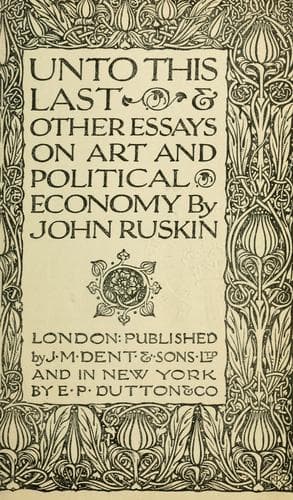
Unto This Last, and Other Essays on Political EconomyRuskin, John
General
Unto This Last, and Other Essays on Political Economy
Ruskin, John
Art; Economics
Farther, such property, for the most part, perishes in the using.
Jewels form a great exception--but rich food, fine dresses, horses and
carriages, are consumed by the owner's use. It ought much oftener to
be brought to the notice of rich men what sums of interest of money
they are paying towards the close of their lives, for luxuries
consumed in the middle of them. It would be very interesting, for
instance, to know the exact sum which the money spent in London for
ices, at its desserts and balls, during the last twenty years, had it
been saved and put out at compound interest, would at this moment have
furnished for useful purposes.
Also, in most cases, the enjoyment of such property is wholly selfish,
and limited to its possessor. Splendid dress and equipage, however,
when so arranged as to produce real beauty of effect, may often be
rather a generous than a selfish channel of expenditure. They will,
however, necessarily in such case involve some of the arts of design;
and therefore take their place in a higher category than that of
luxuries merely.
4. The fourth kind of property is that which bestows intellectual or
emotional pleasure, consisting of land set apart for purposes of
delight more than for agriculture, of books, works of art, and objects
of natural history.
It is, of course, impossible to fix an accurate limit between property
of the last class and of this class, since things which are a mere
luxury to one person are a means of intellectual occupation to
another. Flowers in a London ball-room are a luxury; in a botanical
garden, a delight of the intellect; and in their native fields, both;
while the most noble works of art are continually made material of
vulgar luxury or of criminal pride; but, when rightly used, property
of this fourth class is the only kind which deserves the name of
_real_ property; it is the only kind which a man can truly be said to
"possess." What a man eats, or drinks, or wears, so long as it is only
what is needful for life, can no more be thought of as his possession
than the air he breathes. The air is as needful to him as the food;
but we do not talk of a man's wealth of air; and what food or clothing
a man possesses more than he himself requires, must be for others to
use (and, to him, therefore, not a real property in itself, but only a
means of obtaining some real property in exchange for it). Whereas the
things that give intellectual or emotional enjoyment may be
accumulated and do not perish in using; but continually supply new
pleasures and new powers of giving pleasures to others. And these,
therefore, are the only things which can rightly be thought of as
giving "wealth" or "well being." Food conduces only to "being," but
these to "_well_ being." And there is not any broader general
distinction between lower and higher orders of men than rests on their
possession of this real property. The human race may be properly
divided by zoologists into "men who have gardens, libraries, or works
Public-domain text, read in full here on John Shaqi.
Reviews
Reviews
No reviews yet
Be the first to share your thoughts on this work.
Elsewhere in the archive
Join the Discussion
Join the discussion
Sign in to leave a comment or review.
Sign InorCreate an account