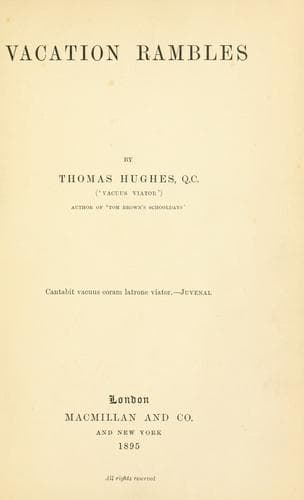
Europe -- Description and travel; United States -- Description and travel
Munich gives one a higher notion of the ex-king; as long as the city
stands, he will have left his mark on it. On every side there are
magnificent new streets, and public buildings and statues; the railway
terminus is the finest I have ever seen; every church, from the
Cathedral downwards, is in beautiful order, and highly decorated; and it
is not only in the public buildings that one meets with the evidences of
care and taste. The hotel in which we stayed, for instance, is built of
brick, covered with some sort of cement, which gives it the appearance
of terra-cotta, and is for colour the most fascinating building
material. The ceilings and cornices of the rooms are all carefully
and tastefully painted, and all about the town one sees frescoes and
ornamentation of all kinds, which show that the people delight in seeing
their city look bright and gay; and every one admits that all this is
due to the ex-king Lewis. But he has another claim on the gratitude
of the good folk of Munich. The Bavarians were given to beer above all
other people, and the people of Munich above all other Bavarians, long
before he came to the throne; and former kings, availing themselves of
the national taste, had established a “Hof-Breihaus,” where the monarch
sold the national beverage to his people. King Lewis found the
character of the royal beer not what it should be, and the rest of
the metropolitan brewers were also falling away into evil ways of
adulterating and drugging. He reformed the “Hof-Breihaus,” so that for
many years nothing but the soundest possible beer was brewed there,
which is sold to the buyers and yet cheaper than in any other house in
Munich. The public taste has been thus so highly educated that there
is no selling unwholesome beer now. A young artist took me to this
celebrated tap. Unluckily it was a wet evening, so we had to sit at one
of the tables, under a long line of sheds, instead of in an adjacent
garden. There was a great crowd, some 300 or 400 imbibers jammed
together, of all ranks. At our table the company were the artist and
myself, a Middlesex magistrate, two privates, and a non-commissioned
officer, and a man whom I set down as a small farmer. My back rubbed
against a vociferous student, who was hobnobbing with all comers. There
were Tyrolese and other costumes about, one or two officers, and a
motley crowd of work people and other folk. The royal brew-house is in
such good repute that no trouble whatever is taken about anything but
having enough beer and a store of stone drinking-mugs, with tops to them
forthcoming. Cask after cask is brought out and tapped in the vaulted
entrance to the cellars, and a queue of expectant thirsty souls wait for
their turn. I only know as I drank it how heartily I wished that my poor
overworked brethren at home could see and taste the like. But it would
not pay any of our great brewers to devote themselves to the task of
selling really wholesome drink to the poor; and I fear the Prince of
Public-domain text, read in full here on John Shaqi.
Reviews
Reviews
No reviews yet
Be the first to share your thoughts on this work.
Join the Discussion
Join the discussion
Sign in to leave a comment or review.
Sign InorCreate an account