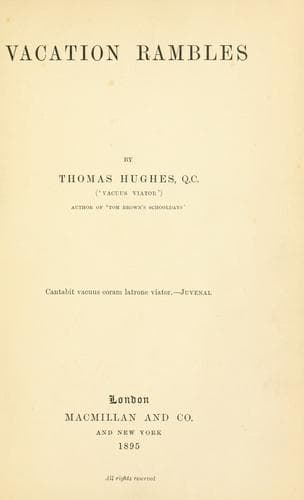
Europe -- Description and travel; United States -- Description and travel
which word “rather” ended every verse of a somewhat vulgar ditty. She
did not get the prize, nor did the matron whom I fixed on as the
winner, who sang without a hitch a monotonous and, I began to think,
never-ending ballad on the rivalries of “young Samuèl” and one
“Barnewell” for the graces of an undecided young woman. The attention
with which this somewhat dreary narrative was listened to deceived me,
for the prize went, without public protest, to a young woman of whose
song I could not catch a line, though I could just gather that it was
feebly sentimental. My impression is that it was her bright eyes, and
pretty face and figure, that carried it with the judges, rather than her
singing. If I am right, it will neither be the first nor last time that
the prizes in this world fall to _tes beaux yeux_.
The school faces the upper end of the village green, and I left it so
crowded that it was a wonder how the dancers could get along at all
with their polkas and handkerchief dances, the latter a kind of country
dance, which were the only ones in vogue. When I got out, I saw lighted
booths at the other end of the green, and went down to inspect. It was a
melancholy sight.
There was the publican’s dancing-booth without a soul in it. One swing
only was occupied in the neighbouring acrobatic apparatus, and the
round-about was motionless. The gipsies were there, ready and eager to
tell fortunes, and with a well-lighted alley for throwing at cocoa-nuts
with bowls rather larger than cricket-balls--the most modern and popular
substitute, I am told, for skittles. There they were, but not a customer
in sight, the only human being but myself being the solitary county
policeman, who patrolled the green with most conscientious regularity,
only slackening his pace for a moment or two as he passed under the
bright open windows of the schoolroom, from which the merry dance-music
came streaming out into the moonlight. I could almost find it in my
heart to pity the publican and gipsies, so overwhelming did their defeat
seem, for not a glass of beer had been allowed all day in the vicar’s
fields, where the cricket-match had been played and all the races
run, on milk, tea, or aerated waters. The whole stock of these last
beverages, supplied from the “Hope Coffee Room,” which has faced the
public-house on the village green now for about three years, was drunk
out before the dancing ended and the school closed on “veast” night, to
the exceeding joy of the vicar’s niece and her lieutenants, two bright
Cornish damsels, handy, devoted, and ardent teetotalers. These three
have been fighting the publicans since 1886, when they started the “Hope
Coffee Room,” supplied with bread, butter, and cakes from the vicarage,
and aerated drinks and light literature, all, I take it, at something
under cost price, though this the three ardent damsels will by no means
admit. The vicar, who is no teetotaler himself, shrugs his shoulders
Public-domain text, read in full here on John Shaqi.
Reviews
Reviews
No reviews yet
Be the first to share your thoughts on this work.
Elsewhere in the archive
Join the Discussion
Join the discussion
Sign in to leave a comment or review.
Sign InorCreate an account