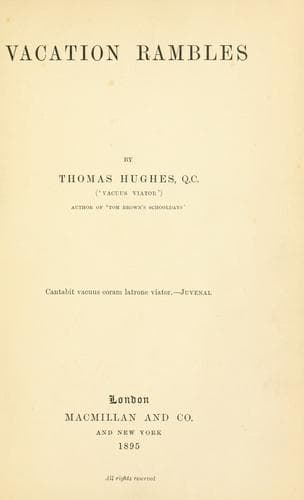
Europe -- Description and travel; United States -- Description and travel
laughingly, plays his fiddle, pays the bills, and lets them have their
own way, with an occasional protest that some night he shall have his
barn and ricks burnt. There is, however, no real danger of this, as he
has lived with and for his poor for more than thirty years with scarcely
one Sunday’s break, and gipsy or publican would get short shrift who
damaged him or anything that is his. I found him quite ready to admit
the great improvement which is apparent in the “veast,” as in many other
phases of rustic life, though he cannot get over, or look with anything
but dislike and distrust at, the cramming and examining system, which,
as he mourns, embitters the only time in the lives of his poor children
which used to be really happy, when they could play about on the village
green and in the lanes regardless of Inspector and Government grant.
Nor am I sure that he does not look with regret at the disappearance
of cudgel-playing and wrestling out of the programme of the yearly
“Veast-Sports.” Cricket, fine game as it is, does hot bring out quite
the same qualities. No doubt there were now and then bad hurts in those
sports, and fights afterwards; but these came from beer, and might
happen just as easily over cricket. So he muses, and I rather
sympathise. As has been well sung by the ould gamester:--
Who’s vor a bout O’ vrendly plaay,
As never should to anger move,
Sech spworts be only meant for thaay
As likes their mazzards broke for love.
But I should be sorry to believe that there are fewer youngsters to-day
in the West country who “likes their mazzards broke for love” than there
used to be half a century ago.
The Divining-Rod, 21st September 1889.
About a quarter of a century ago, I had the chance of seeing some
experiments in the search for water by the use of “the divining rod” on
a thirsty stretch of the Berkshire chalk range. Oddly enough (what a lot
of odd things there are lying all round us!) at the highest points of
this very range you might come on “dew-ponds,” which never seemed to run
dry, though how the white chalky water got there, or kept there, no
one, I believe, has ever been able to explain from that day to this. But
these “dew-ponds” were of no use, of course, to the cottages scattered
along the hillside, and whoever wanted spring-water, had to go down
about 400 feet for it. Well, I neglected that chance, and ever since
have been regretting it.
Public-domain text, read in full here on John Shaqi.
Reviews
Reviews
No reviews yet
Be the first to share your thoughts on this work.
Elsewhere in the archive
Join the Discussion
Join the discussion
Sign in to leave a comment or review.
Sign InorCreate an account